NEW YORK — U.S. consumer confidence declined for a second consecutive month in August as Americans grew more pessimistic about future business and labor market conditions, even as their assessment of the current job market improved, according to The Conference Board.
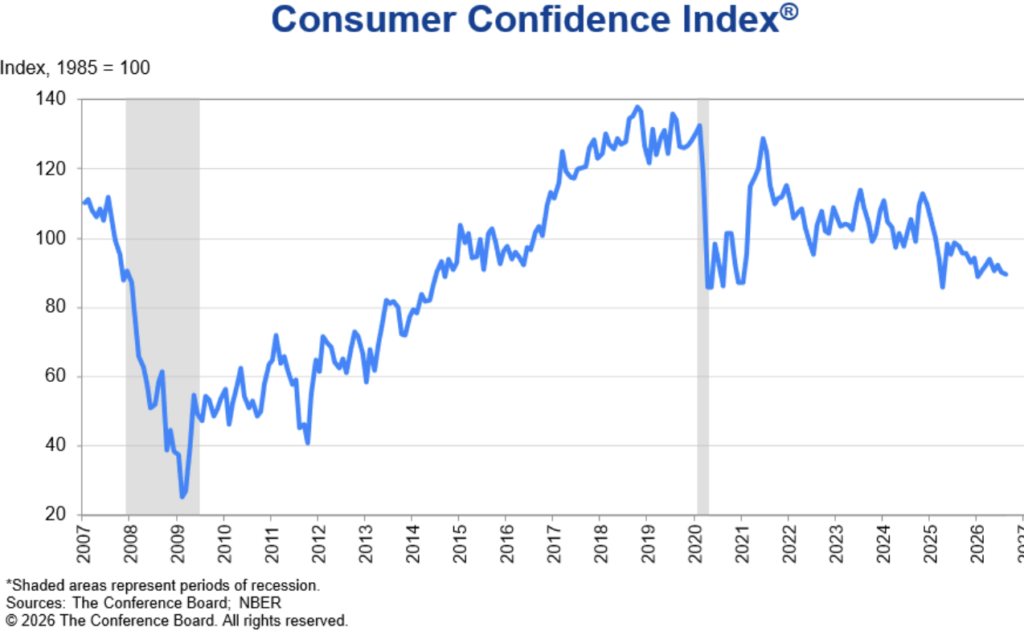
The Conference Board Consumer Confidence Index fell 0.8 points to 89.4 in August from 90.2 in July. The index uses 1985 as a base of 100.
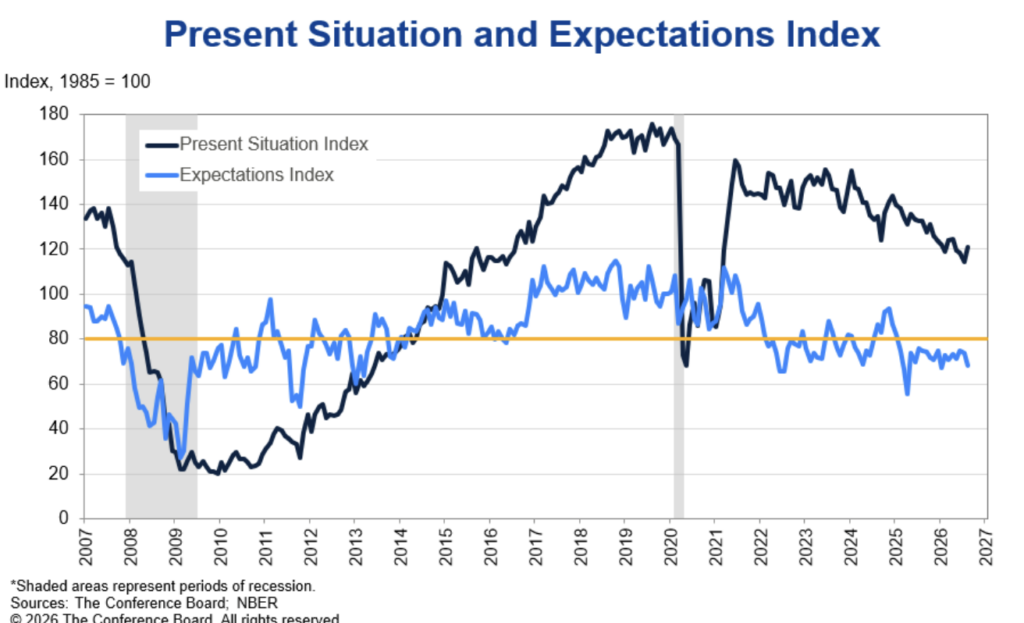
The decline was driven by weakening expectations for the months ahead. The Expectations Index, which measures consumers’ short-term outlook for income, business and labor market conditions, fell 5.8 points to 68.2.
By contrast, the Present Situation Index rose 6.8 points to 121.2 after three consecutive months of declines.
“Consumer confidence moderated slightly in August for a second consecutive month,” Dana M. Peterson, chief economist at The Conference Board, said in a statement.
Peterson said consumers’ assessments of current business conditions were mildly positive and perceptions of the labor market improved. But consumers became more pessimistic about business and employment conditions over the next six months.
“Expectations for household incomes moderated but remained optimistic overall,” Peterson said.
The preliminary August survey was conducted from Aug. 3-16.
Current Labor Market Views Improve
Consumers’ perceptions of current employment conditions improved significantly in August, according to The Conference Board.
The labor market differential — the percentage of consumers saying jobs are “plentiful” minus those saying jobs are “hard to get” — increased 4.8 percentage points to 7.5%.
The improvement was driven primarily by more consumers reporting jobs were plentiful and fewer saying jobs were difficult to find.
The Findings
Among the findings:
- 27% said jobs were plentiful, up from 24.4% in July.
- 19.5% said jobs were hard to get, down from 21.7%.
- 18.9% described current business conditions as good, down slightly from 19.1%.
- 17.6% described business conditions as bad, down from 17.9%.
The Conference Board said the changes pushed consumers’ net assessment of current business conditions up 0.1 percentage point to 1.3%.
Expectations Deteriorate Across All Components
While views of the present improved, all three components of The Conference Board’s Expectations Index deteriorated.
Net expectations for business conditions fell 2.5 percentage points to negative 6.3%, while net expectations for the labor market dropped 2.6 percentage points to negative 11.5%.
Net expectations for household income declined 3.1 percentage points but remained positive at 3.8%.
The survey found:
- 16.8% expected business conditions to improve over the next six months, down from 17.8% in July.
- 23.1% expected business conditions to worsen, up from 21.6%.
- 14.6% expected more jobs to become available, down from 16.4%.
- 26.1% expected fewer jobs, up from 25.3%.
- 17.6% expected their incomes to increase, down from 19.5%.
- 13.8% expected their incomes to decline, up from 12.6%.
Prices, War and Jobs Weigh on Consumers
Consumers’ written comments about factors affecting the economy became slightly more pessimistic in August, The Conference Board said.
References to prices remained elevated, including concerns about oil and gasoline costs. Consumers also increased their references to war and conflict, food and grocery prices, trade and jobs.
On a six-month moving average basis, confidence declined slightly across all age groups, although consumers younger than 35 remained the most confident.
Higher-income consumers generally expressed greater confidence than lower-income groups, although results were mixed across income categories.
Gen Z continued to report the highest confidence on a six-month moving average basis, followed closely by Millennials. Generation X, Baby Boomers and members of the Silent Generation trailed by a wider margin.
By political affiliation, confidence among Independents and Republicans weakened, while Democrats became somewhat more positive in August, according to The Conference Board.
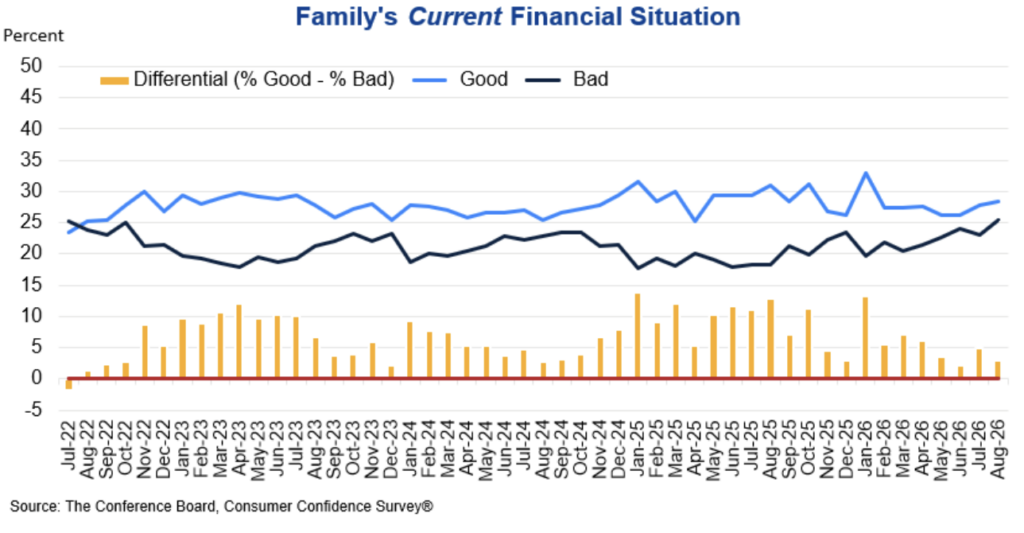
Auto Buying Plans Remain Strong
Consumers’ purchasing plans also offered a mixed picture.
On a six-month moving average basis, expectations for automobile purchases remained strong. Homebuying expectations declined slightly in August but continued an upward trend after falling to decade lows in early 2024.
Among durable goods, furniture and smartphones remained the products consumers were most interested in purchasing during the next six months, although smartphone purchasing expectations continued to moderate.
Plans to buy televisions recorded the largest decline on a six-month moving average basis, while purchasing plans for most other durable goods weakened slightly.
Consumers Pull Back on Some Service Spending
Anticipated spending on services declined in August following an increase in discretionary spending plans in July. The Conference Board said lower gasoline prices and the summer’s World Cup may have increased consumers’ willingness to spend in July.
Despite the August pullback, consumers still expected to spend more overall on services during the next six months.
Restaurants, bars and takeout; utilities; and streaming, internet and mobile services ranked among consumers’ top three planned service-spending categories.
Consumers expected to spend less on beauty and personal care as well as several discretionary activities, including:
- Movies.
- Hotels for personal travel.
- Airfare.
- Amusement parks.
- Museums and historical sites.
Planned spending on pet care remained strong, The Conference Board said.
The monthly Consumer Confidence Survey is conducted online for The Conference Board by Toluna, a market research and consumer insights company. The preliminary August results had a cutoff date of Aug. 16.