
WASHINGTON — The number of mortgages at least 90 days past due rose in August, ending five consecutive months of improvement, even as early-stage delinquencies remained below year-earlier levels, according to Intercontinental Exchange.
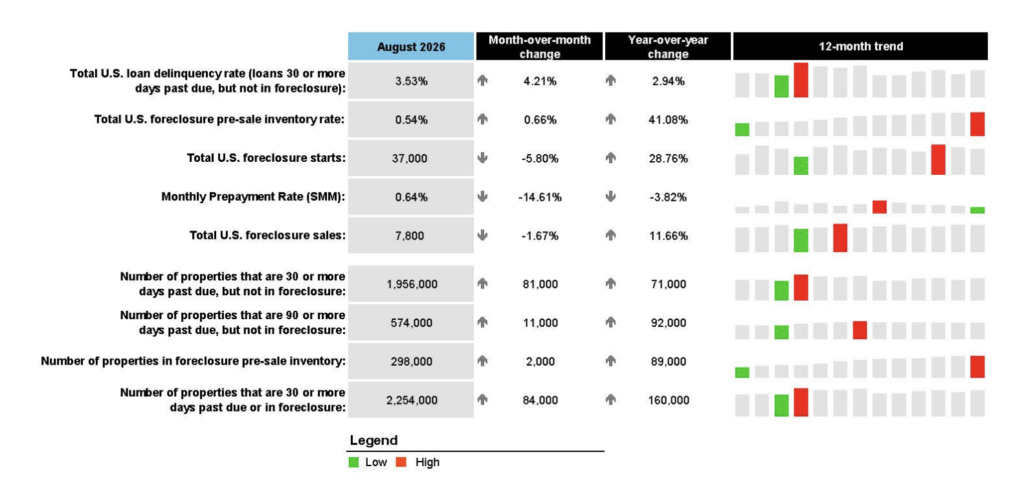
ICE’s latest First Look report showed serious delinquencies increased by 11,000 during August to 574,000. That was 92,000 loans, or 19%, more than a year earlier.
The increase followed improving performance in July, when 64,100 borrowers brought seriously delinquent loans current, the strongest recovery activity since October 2025. New defaults also had been below year-earlier levels in four of the five months through July, according to ICE.
Although the number of mortgages 30 and 60 days past due increased in August, there were still 21,000 fewer such loans than a year earlier. The figures suggest pressure remains concentrated among borrowers already substantially behind on payments.
Overall Delinquency Rate Remains Historically Low
The national mortgage delinquency rate increased 14 basis points in August to 3.53%, up 10 basis points from a year earlier, ICE reported. A basis point is one-hundredth of a percentage point.
ICE said much of the monthly increase reflected calendar effects. After accounting for July’s calendar-driven decline, the rate was effectively unchanged.
August’s overall delinquency rate was 35 basis points below its August 2019 level and lower than every August reading before the pandemic in ICE’s records.
Mortgages at least 90 days past due accounted for 1.04% of active loans, roughly matching the 1.03% August average from 2017 through 2019. Nevertheless, the number of seriously delinquent loans was substantially higher than a year earlier.
The August increase interrupted progress following elevated readings earlier this year. In May, serious delinquencies were 21% higher than a year earlier, while early-stage delinquencies remained below 2025 levels, according to previously reported ICE figures.
FHA Borrowers Face Greater Pressure
Separate industry data indicate that financial distress has been particularly pronounced among borrowers with Federal Housing Administration-insured mortgages.
The Mortgage Bankers Association’s second-quarter National Delinquency Survey, released last month, showed FHA serious delinquencies increased 227 basis points from a year earlier. That compared with increases of 6 basis points for conventional mortgages and 31 basis points for Department of Veterans Affairs loans.
ICE reported in July that new FHA defaults were down 13% from a year earlier, suggesting fewer borrowers were newly falling behind even as others struggled to catch up.
Limited home equity can complicate recovery. National Mortgage Professional reported last month that 320,000 homeowners entered the third quarter both delinquent and underwater — owing more on their mortgages than their homes were worth — nearly twice as many as a year earlier.
Those underwater borrowers were heavily concentrated among recent FHA and VA loans, potentially limiting their ability to sell or refinance to resolve payment difficulties.
Foreclosure Starts Decline, Inventory Rises
Foreclosure activity did not increase at the same monthly pace as serious delinquencies, ICE reported:
- Foreclosure starts fell nearly 6% in August to 37,000, although they remained 29% higher than a year earlier.
- Completed foreclosure sales declined 2% to 7,800, representing 57% of their August 2019 pace.
- The share of loans in foreclosure before a completed sale held at 0.54%, matching its highest level since February 2020.
- Active foreclosure inventory increased by 2,000 loans, the smallest monthly increase since November 2025.
Despite the slower monthly growth, 298,000 properties were in active foreclosure, an increase of 89,000, or 41%, from a year earlier.
The Community Home Lenders of America recently called for an emergency liquidity backstop through Ginnie Mae, warning that a sharp increase in FHA, VA or U.S. Department of Agriculture loan delinquencies could strain independent mortgage banks required to continue advancing payments to mortgage-backed securities investors, according to National Mortgage Professional.
Housing Costs Add to Borrower Vulnerability
Taken together, the figures show continued stress among seriously delinquent borrowers despite comparatively low overall delinquency rates and fewer early-stage delinquencies than a year earlier.
Recent government-backed borrowers can face particular challenges because smaller down payments and limited equity provide less protection against financial setbacks.
National Mortgage Professional’s analysis also highlighted the importance of recurring housing expenses beyond the mortgage payment. Property taxes, homeowners insurance, association fees and other costs can increase after a loan is originated, leaving borrowers with limited savings less able to absorb a job loss or other disruption.