
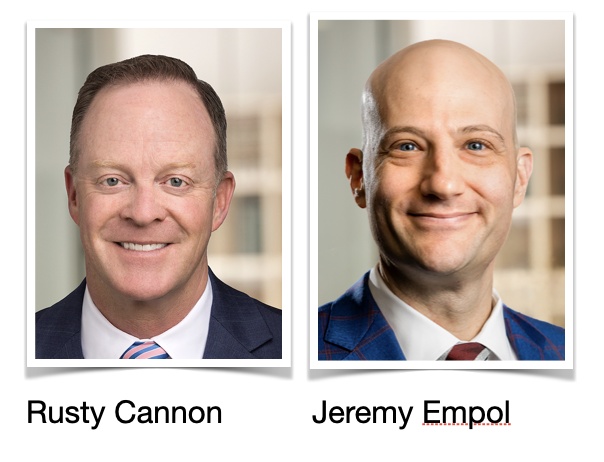
By Rusty Cannon and Jeremy Empol
A year ago, the leagues representing credit unions in California, Nevada and Utah made a deliberate choice: stop asking advocacy to compete with everything else for resources and build a structure where it no longer has to.
That structure is Fuel Solutions. And one year in, it is working.
Let’s be direct about what Fuel Solutions is and is not. It is not a multi-state league merger. California’s Credit Unions, Nevada’s Credit Unions, and Utah’s Credit Unions each remain fully independent — separate boards, separate governance, separate advocacy agendas shaped by their own members and their own political environments. No state’s priorities are subordinated to another’s.
What is shared is the infrastructure. Fuel Solutions carries education, events, compliance resources, business solutions, and communications — delivered at scale across all three states. Member credit unions never see it. Staff carry their state league’s business cards and email addresses. Events carry their state league’s name. The member experience is identical to what it has always been. What changed is how sustainably and effectively it is delivered.
This isn’t a new idea, exactly. Plexcity proved years ago that leagues could share back-office infrastructure — accounting, HR, IT — without losing their identity or independence. Fuel Solutions takes that same logic and extends it forward: from back-office functions into the full member-facing service portfolio. As the scale pressures on leagues continue to grow, the Fuel model becomes not just viable — it becomes the answer.
Advocacy Gets What It Deserves
The efficiencies created by Fuel Solutions have directly funded greater advocacy capacity. California and Nevada have added one new full-time advocate at the state level — serving both states — and one new full-time advocate at the federal level, also serving both. Two people. Real positions. Funded by structural efficiency, not dues increases. In Utah, the efficiencies are already moving the needle toward redirecting resources toward greater member value, and the new structure has already ramped up state PAC capacity.
The results speak for themselves. This was the same year California’s advocacy team successfully protected credit unions against legislation that would have brought them under the Community Reinvestment Act. That outcome did not happen by accident — it happened because advocacy was properly resourced. In addition, Utah’s advocacy efforts resulted in one of the first Financial Crimes Intelligence Centers in the nation being fully funded and stood up by state funding in cooperation with the Utah Attorney General’s office. This will be a game changing event in fighting back against financial fraud in Utah.
Our combined legislative, regulatory, and political footprint is larger today than it was a year ago. Not because budgets grew, but because the model freed resources that were previously absorbed by service delivery overhead.
Fuel Has Its Own Credit Union Affairs Team
The most important internal development of year one is the launch of Fuel’s Credit Union Affairs department. Much like each league has its advocacy or government affairs function as its organizational core, Fuel now has a dedicated team whose focus is association and member management — the programs, services, and member relationships that keep credit unions engaged and supported.
This isn’t duplication of the leagues’ advocacy work. It’s the operational mirror of it. The leagues handle the political and regulatory fight. Fuel’s Credit Union Affairs team handles the member-facing infrastructure that supports it. Together, the model functions as a complete ecosystem — each side doing what it was built to do, neither pulling resources from the other.
Collaboration as the Path to Independence
There is a counterintuitive truth at the heart of this model: the best way for a league to preserve its independence is to collaborate strategically. Scale pressures do not ease over time. The cost of delivering high-quality member services does not shrink because a league is small. What changes is how those costs are carried — alone or shared across a structure built for exactly that purpose.
Fuel Solutions is that structure. Every league that participates spreads fixed costs further, strengthens the service portfolio, and frees more resources for the advocacy work that justifies a league’s existence in the first place. Member collaboration across California, Nevada, and Utah has grown. Communications are more streamlined. And the three leagues — each fully sovereign, each fighting for its own members on its own terms — are stronger together than any one of them could be alone.
Independence is not preserved by going it alone. It is preserved by building the right partnerships. That is what the alliance is. That is what Fuel Solutions delivers. And one year in, we are just getting started.
Rusty Cannon is President & CEO of Utah Credit Unions. Jeremy Empol is President & CEO of California Credit Unions and Nevada Credit Unions.