
SACRAMENTO, Calif.–The battle of dueling op-eds among former credit union CEOs over the proposed merger between California-based SAFE Credit Union and Washington-based BECU continues in a local newspaper, with a new piece authored by a retired CEO who said she spent three hours meeting with SAFE’s CU.
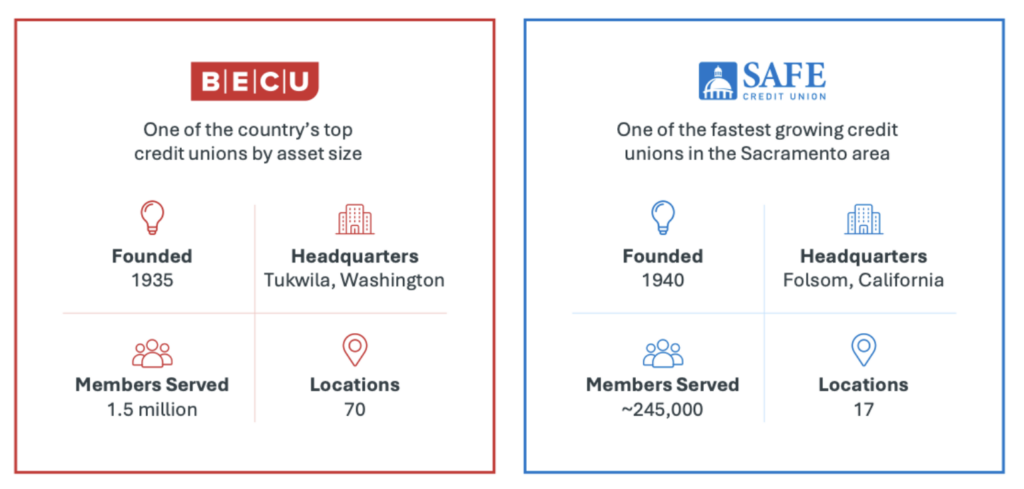
As the CU Daily has been reporting, if the merger gets the OK it would create the nation’s fourth-largest credit union by assets at approximately $34-billion, with 1.8 million members and 80 locations.
If approved, the merger is expected to close Jan. 1, 2027.
The combined institution would serve approximately 1.8 million members through more than 80 locations and manage more than $34 billion in assets. The deal also includes nearly $15 million in payouts to five top executives at SAFE CU.
As the CU Daly also reported, former SAFE CU CEO Dave Roughton published an op-edin the Gold Mountain News in favor of the merger, after former credit union CEOs Stan Hollen and John Tippets authored op-eds questioning the combination, as the CU Daily reported here and here, respectively.
Now, former credit union CEO Jeanine Morse has responded to Roughton’s article with one of her own.
Evaluation Questioned
“Former SAFE Credit Union CEO Dave Roughton claims he ‘evaluated’ the proposed takeover of SAFE by Boeing Employees Credit Union (BECU) with one guiding directive – ‘member benefit’,” wrote Morse, a SAFE member since 2003 who currently lives in Elk Grove, Calif. And who was CEO of University of Hawaii FCU prior to her retirement. “But in doing so he disregards the truth: SAFE CREDIT UNION WILL CEASE TO EXIST BECAUSE OF THIS DEAL.
“The benefits are illusory. SAFE Credit Union will be gone, and all current SAFE members will lose an institution that successive generations built up over 81 years. SAFE resources will become the property of BECU, including all member-owner income accumulated since 1940,” Morse continued. “You cannot ‘fortify’ an institution that no longer exists. And a credit union in Washington state cannot “enhance the local communities” when it has no connections to our region.
“As a former credit union CEO, I analyzed the available financial and statistical data for both institutions. The facts contradict Mr. Roughton’s claims of lower fees, higher deposit rates and lower loan rates. I compared the bounced check (NSF) and returned check fees for both credit unions. My objective findings raise serious questions.
“SAFE’s NSF fee is $14, with a limit of 2 NSF fees daily for a maximum of $28. BECU’s NSF fee is $10, with a limit of 5 fees daily for a maximum of $50. In this scenario, SAFE members end up paying an additional $22,” Morse continued. “This is also true for check deposits on ‘hold.’ If checks try to clear against “hold” deposits, BECU charges another $10 each. SAFE does not. A member charged the maximum at BECU pays $72 more.
“Conclusion: Boeing Employees Credit Union charges higher NSF fees.
BECU Lacks LID Designation
“The federal government has given SAFE a low-income designation (LID). BECU does not have this designation. A LID designation means the government determined that a majority of SAFE members have family incomes at or below 80% of the Sacramento area median. Lower income members are more likely to incur overdraft fees, with frequent users experiencing substantially greater financial vulnerability.
“On Sept. 22, I met with SAFE CEO Fay Nabhani for three hours. The meeting was unproductive because Ms. Nabhani refused to disclose details of the due diligence performed by SAFE,” Morse continued. “When I suggested SAFE already has the financial resources to reduce or eliminate some of their fees, she replied SAFE could not afford to absorb a $7 million reduction in income. When I suggested she could increase loan income to offset this expense, she replied SAFE needed more capital to increase loan volume. I did not understand this illogical response. When I pointed out that SAFE’s rates were much better than BECU’s, she stated there would be ‘regional pricing’ after the merger. But the merger agreement does not specify this.
“According to Mr. Roughton, “There would be a 30-percent increase in direct financial return … including benefits from lower loan rates, higher deposit rates and reduced fees …” but he does not provide any data to substantiate this claim.”
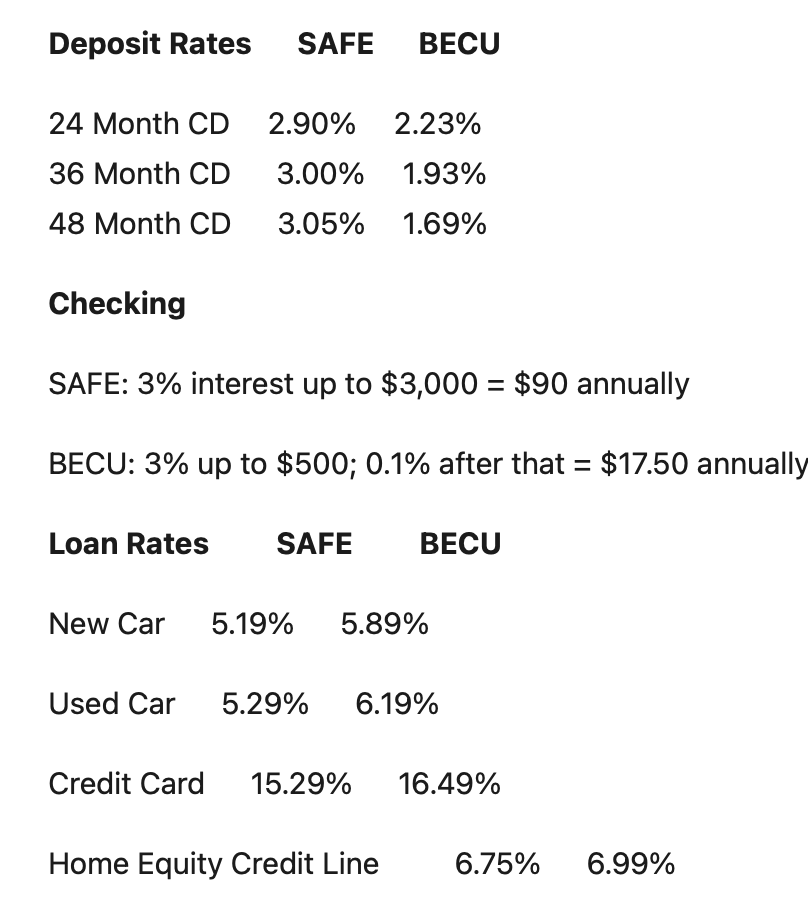
Rate Comparison
In her op-ed, Morse provided this rate comparison which she said was based on the credit unions’ respective websites.
The Takeaways
Morse offered these “takeaways” from her analysis:
* BECU claims lower fees but the method by which they are assessed costs members more.
* SAFE charges less for loans and pays more for deposits. This is the main reason for which credit unions exist. “BECU profits much more from their members.”
* “The strategy at BECU is obvious: Lower fees counterbalanced by higher loan rates and lower deposit rates. This is a for-profit mentality. SAFE members will pay more for loans and earn less on deposits. And higher loan rates are a certainty for members who fall into the low-income category.””
“Summary – SAFE Credit Union has $4.4 billion in assets and $3.9 billion in member deposits. Given its size, its financial strength, and an objective analysis of its fee and rate structure, there is no logical argument to be made for a “merger” that terminates its existence and transfers all its assets to an entity in Washington state,” wrote Morse. “SAFE Credit Union has been a trusted financial services provider in our community for over eight decades. As a member since 2003, I believe it is essential that we keep SAFE healthy and strong, in Sacramento, with local leadership.”