PALM DESERT, Calif.–Just what is your level of stage intelligence? Understanding that, as well as the stage from which members of your team or others in your organization view the world, can be the key to whether projects succeed or fail–not to mention go a long way toward better professional and personal relationships—according to one person.
Arel Moodie, an Adult Development Theory expert, author and speaker, told credit union leaders gathered here for the California and Nevada leagues’ REACH Conference that they can “unlock the power of their people” by transforming workplace dynamics from friction into excellence. And that means understanding perspectives.
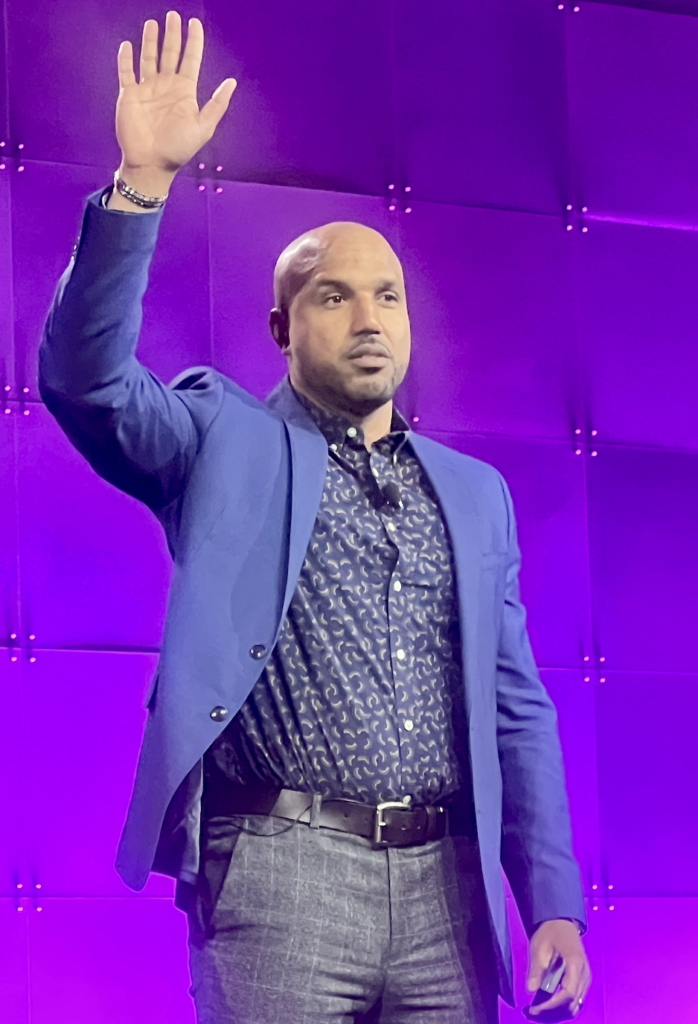
Moodie, who built his first million-dollar company before age 20, who has founded other tech companies and who also hosted the Disney Plus show “Family Reboot,” said he has been “studying what makes people tick for more than 20 years,” several interesting aspects of which he shared with the meeting.
Moodie said his objective was to share “specific strategies for demystifying the complexities of human dynamics to connect with and influence people.”
As he explained, “When you interact with someone there is a primary stage where you see the world. Conflict shows up when you are trying to solve the same problem from a different stage than someone else.”
“I am a big believer that it’s not what stands in front of you; it’s about who stands beside you,” he told the meeting. “There are two kinds of fires. External fires that will never, ever go away, and internal fires, which the ones we choose. They are optional. It’s the feeling of that quote, ‘Everyone brings joy to this office: some when they enter some when they leave.’”
Navigating Two Worlds
Moodie, who grew up in a Brooklyn project, said his background and upbringing have shaped his interest in human dynamics. He said his father is Jamaican and his mother a white, Jewish woman, making him a “Jewmaican.” He said he grew up having to navigate between two totally different worlds.
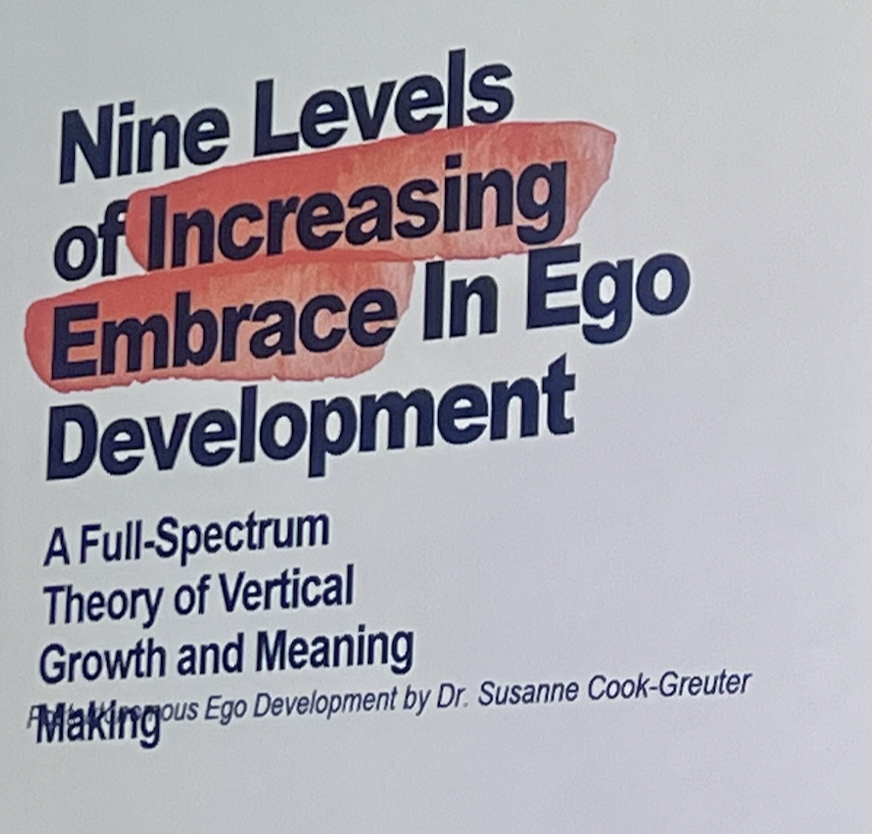
Moodie’s work and his comments are based on a research paper titled, “Nine Levels of Increasing Embrace in Ego Development. A full spectrum theory of verti9cal growth and meaning making.”
But from that long title, he focused on four life stages, the understanding of which he said can vastly affect the effectiveness of a leader.
“This research has proven that all humans have these predictable and sequential stages of development,” he said. “Each one of these stages has a different way to make sense of the world, of what motivates us, of what pisses us off, and if we can understand those, we can understand why we care about things the way we do and others care about the things they do. Everything I do is really simple. It’s about taking the complexity of humans that creates friction and turning it into excellence.”
The Four Stages
The four stages of adult development that were highlighted by Moodie included:
Focused Four Stages of the Nine
- Personal/Self-Centric
- Belonging/Group-Centric
- Tactical/Skill-Centric
- Strategic/Achiever
As Moodie explained, the stage a person is in is not dependent upon age. Some people stay in the same stage throughout their lives.
“Generations make decisions based on how old you are. Adult development equals how mature you are. Maturity is pegged to each stage, and the more you understand the stages, the more deeply you understand stage intelligence,” he explained. “It allows for the proper decision-making based on what that stage is giving you.”
Personal/Self-Centric
The Definition: This is “I want to do what is important to me and don’ t make me do anything I don’t want to do.
Characteristics: “This stage happens around 18-21 years old. I win/you lose. Someone is useful/useless to me,” Moodie said. “If I want to win, I build two selves. My inner self/outer self. The more information people have on me, the more power they have over me. This is why gossip moves so quickly.”
Biggest Fear: “The fear at this stage is that someone else will dominate me. I don’t want to ever feel like you have taken advantage of me.
How the Self-Centric Take Action: “The focus is on personal gain. They are motivated by ‘How do I win/; It creates competition that can either drive or divide. You can ignore this at your own peril. If you only focus on this stage, you are creating a self-centric environment, and that creates a lot of you vs. me, me vs. the world. We can unconsciously drive the exact kind of behavior we don’t want to.”
Summation of Stage One: What does this mean for me?
What causes us to move out of this stage is, “I have been trying to do everything myself, and it’s not working. I don’t feel connected, and you move into the next stage,” Moodie said.
Group Centric/Belonging
The Definition: This stage is “we-based.”
Characteristics: “It’s a group of people who are your people,” Moodie said. “This conference is your people. If someone attacked the group, you feel like they are attacking you. That’s how you know when you’ve found your group. What you care about here is having a sense of belonging. You want them to represent you, and you want to represent them.
Concern: “What causes the internal fires is when the us vs. them is inside your credit union, when it’s one department vs. another, or when it’s executive leadership vs. those in the field.”
Biggest Fear: “The biggest fear in this stage is being ostracized from the group. So, you may be purposely difficult just so not perceived as being part of another group. This builds unity but can create silos.
The Next Step: “A fascinating change can happen that can move you out of this group.”
Tactical/Skill-Centric
The Definition: “You develop a skill to move on out of the group, and your skill becomes who you are. When you are skill-centric, you love everyone, but you’re not like everyone. When your skill is who you are, you can do something fascinating: you might sound like a jerk to people, because you care so much about your skill. When you see something wrong, you have to point it out. If you have an a-hole in your office, it may be that they have the skills to see where the holes are. Maybe they aren’t being critical; maybe they are trying to solve a problem from a different stage. And the phrase they use is, ‘Yes, but…”
Biggest Fear: “The biggest fear of someone who is skill-centric is that you are actually not special. This is the imposter syndrome that all of us have. Anytime something confirms that you are not that good, it feels like an attack on the soul. Managers who are skill-centric don’t like delegating.”
Taking Action: “They look for the best, most practical solutions and actions. It elevates quality but may create friction.”
Strategic/Achiever Stage
Worth Noting: At this stage you are asking a completely different set of questions, according to Moodie.
The Definition: “An achiever doesn’t have to be the best player on the team, they want to be the coach who builds the championship culture,” he said. “You start caring about what makes people tick, not because they are useful/useless to you, but because you want to get the most out of that person. You start to look at the past and the future exactly the same. When you become a strategic achiever is you become goal obsessed. You must hit every goal you set in your life. And then when you hit the goal, you set a new one.”
The Fear: “What happens at this stage is not being successful is interpreted as a betrayal of one’s deepest potential,” Moodie said.
How the Achiever Stage Takes Action: “Work is done to create better results and being strategic. This accelerates progress through unity.”
Unlocking the Door
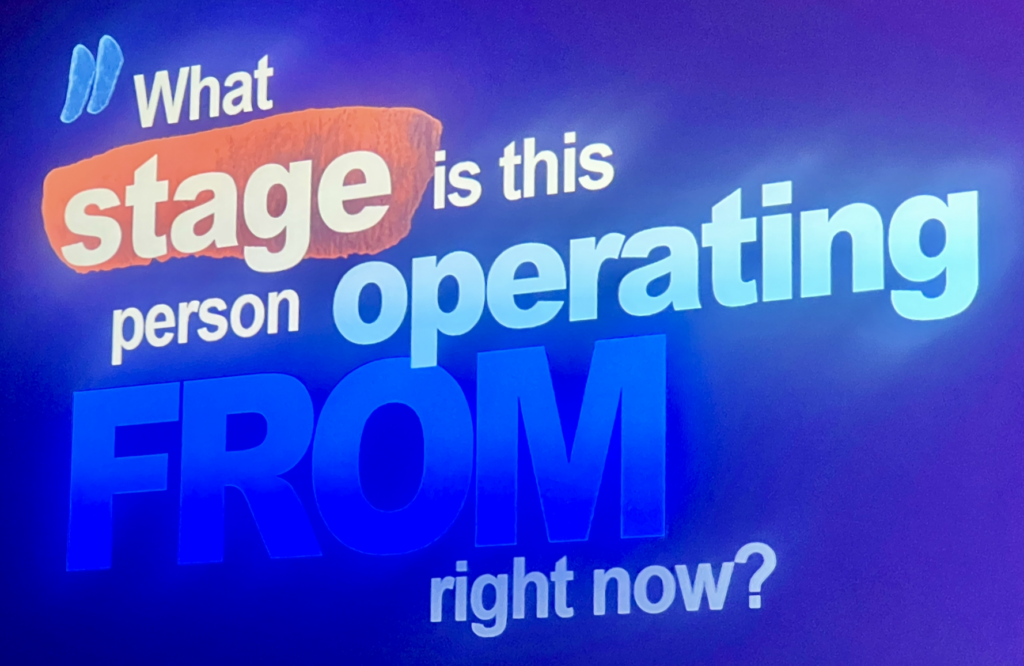
Those who are able to ask themselves, “What stage is this person operating from right now?” will unlock the potential of individuals and organizations, according to Moodie.
“If you can ask this question, and see it in them and yourself, you can open up incredible doors and turn friction into action,” Moodie said.