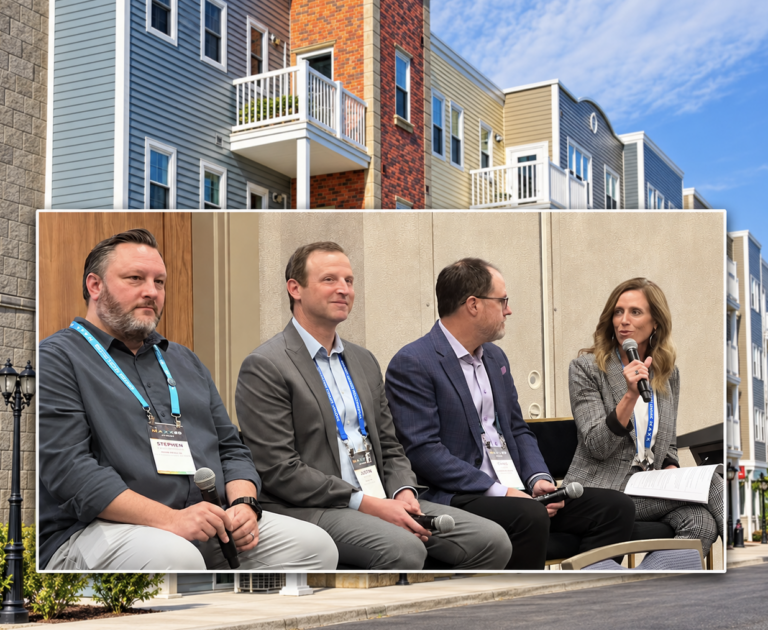
AURORA, Colo.–Three credit unions that have undertaken some of the most innovative programs in the country for getting people into housing—especially communities that face long odds of ever becoming homeowners–shared how their programs work, what they are doing with other partners, offered some advice and lessons learned, as well as some thoughts on how to be thinking about ROI.
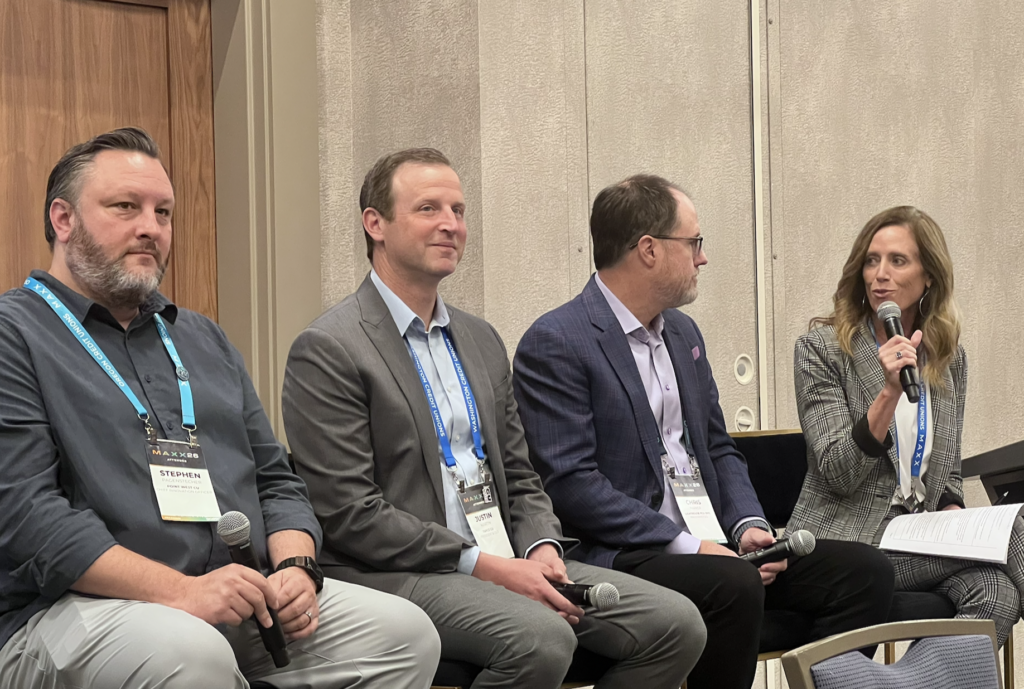
Sharing details of their respective programs at the GoWest Credit Union Association’s MAXX Conference here were:
- Chris Parker, president and CEO of Lighthouse Credit Union in New Hampshire
- Justin Martin, president and CEO of TAPCO Credit Union in Tacoma, Wash.
- Stephen Pagenstecher, chief innovation officer with Point West Credit Union in Portland, Ore.
The discussion was moderated by Charlotte Nemec, president and CEO of Canopy Credit Union in Spokane.
Here’s a look at some of what they had to say:
Nemic: Tell us about your CU and communities, and what is your mission and purpose:
Parker: We are in New Hampshire and Maine and have 171,000 members with 17 branches. Our mission is to enrich and nourish the lives of others, and that’s both our employees and members.
Martin: We are in Tacoma, Wash. We were founded to serve city employees who weren’t getting the financial services they needed. We now serve everyone who lives, works or worships in the State of Washington. Our mission is to bring humanity to financial services. Everyone we deal with is a person with a different lived experience and they are using our credit union to advance their well-being.
Pagenstecher: Our capital at one point had hit four and some change in capital, and we had a real reflection on why we are doing this; we can be something else. We are different than other organizations. We are about providing financial access to underserved communities and immigrants, particularly the Hispanic community. We have just one branch, but we expanded our FOM during the pandemic. Our mission is to be a shining light in the darkness. It’s exciting to show up and do that every day.
Nemic: Tell us about how housing has become a major strategic priority for Lighthouse.
Parker: It starts with the why. We thought deeply about who we were and went back to our mission. What are the areas of need? We are very myopic. Our members have told us over and over again it’s food security, financial education and housing. And housing has become our North Star. With our Pathways program, we set a goal of helping 50,000 people with stable housing by 2030. We had been doing approximately 150-200 first mortgages every year. What’s important to who we are is what kind of impact we’re having. We are now doing something that is connecting all of our team. At the end of the first year, we were at 5,000 (mortgages) and now are on our way to 10,000 by the end of this year.
Nemic: Tell us more about your specific housing initiatives and the removal of specific barriers to homeownership.
Parker: When you are doing first mortgages and you put a vision in front of yourself, the first thing you do is ask what can you do. The first thing we did was auxiliary dwelling unit (ADU) loans, and we actually created a playbook. That addresses the issue of inventory. There was not a lot of inventory, and having an ADU was really important. This is about helping municipalities, as there are a lot of challenges with ADUs. It is not one solution, it’s multiple solutions.
We have a first-of-its kind homeownership program called Pathways for first-time homebuyers. If you have a parent or guardian relationship with someone who will make a $50,000 investment in a CD, that gets you into a 100% LTV with no PMI. For the average home in New Hampshire, that saves $500 to $600 a month. We have also just added 40-year mortgages.
When people ask why protecting interchange is important, it’s interchange that helps us to pay for all these products. Every one of these we portfolio, so you have to have non-interest income.
Our housing partnership includes other credit unions, builders and developers, and we asked, with all of us are doing something unique individually, is there something we can do collectively? The answer was Pathways. There are now 41 organizations involved.
The second thing was building a development fund. We are now actually talking with several of other credit unions about that.
Nemic: What insights have you gained and what challenges you have faced?
Parker: The first thing is to listen to what the members actually need. It’s great to have great ideas, but you need to know what’s important to them. One thing we’re hearing now is that having access to stable housing is about renting, it’s not about homeownership anymore. Homeownership as the American Dream is shifting.
The second thing we’ve learned is it’s about having multiple (strategies).
And third, you have to be willing to lean into taking risk.
Nemic: How do you evaluate risk while still driving innovation?
Parker: We are watching all the typical risks, but what we think about is what is the risk of not taking action, not doing something. We think about that all the time. The Pathways program is a multi-million-dollar investment. If you are just looking at loans and originations, you are looking at this the wrong way. You have to think about how we now have a technology program we didn’t have before. It’s not a throwaway.
More importantly, we have cultural wins in what we have taught our teams. You have to be willing to put your foot in the ground. In the 18 months of Pathways, we’ve had one person go from start to finish. But we’ve had others we’ve put into other programs.
Nemic: Why has housing emerged as a strategic priority for Point West?
Pagenstecher: If you are really dedicated to improving the financial wealth of a community, homeownership is right at the top of the list. In a time when housing is less accessible than any other time in the last 20 years, that’s a challenge; it takes innovative solutions. It takes people raising their hands and saying this is important.
One thing we are proud of is we were approached by a housing non-profit that needed an ITIN lending product. It took us years. We don’t originate mortgages at Point West. We work with Consolidated Community Credit Union. We make the decisions. We couldn’t have done it on our own and partnerships are what makes the world go round for organizations like ours. Over time, we developed our own 30-year fixed ITIN mortgage product. We have our own servicing and portfolio, and we have almost 20 of those loans in portfolio. We want to be a high-impact credit union and maximize return to our community.
Nemic: What are community land trusts and what do they do?
Pagenstecher: We work with the largest community land trust west of the Mississippi in Portland: Proud Ground Land Trust. They own the land underneath the property in perpetuity. They are also a developer of multiple types of homeownership. Because they have part ownership of the property itself, they are able to get people into those homes at a far lower LTV. If down the line they need to sell, they will split whatever the net proceeds are from the home.
A community land trust is really about leveling the playing field. It’s a unique model.
Nemic: Do you get prequalified candidates through Proud Ground?
Pagenstecher: Yes. And Consolidated Credit Union has gotten really good at this. They are an important extension of our team.
Nemic: What has Point West learned?
Pagenstecher: These are really good borrowers. We knew that from our ITIN lending. The delinquencies are less; the charge-offs are less. They have the same needs as everyone else.
Nemic: TAPCO has a social impact banking philosophy. What is that about?
Martin: It’s a relatively new philosophy and not something we made up. It’s based on this premise that financial institutions have gotten more into value extraction than value creation, and how do we get back to this value creation model. They came up with this framework: How do you impact issues of people, issues of planet, such as energy efficient loans, and how do you impact issues of prosperity.
We have taken that model and with our strategic plan it is a guide to where we want to invest.
First and foremost, we really try to come in as a community partner, not a financial institution. We enter into conversations on issues impacting the community and we begin by listening. What we hear frequently is that when communities deal with financial institutions, it’s often the financial institutions prescribing, saying, ‘Here is the solution we have for you,’ instead of listening to the problem or asking, ‘How can we co-create?’
Nemic: Tell us about your housing program.
Martin: I think housing is the number-one challenge I hear. We were able to stand up some programs that created trust in the community. One of our partners is one of the largest school systems in the state. They had this idea around how to help unhoused students. What they couldn’t find was a financial institution to partner with. They had MOUs in place with other organizations, but the barrier was to get people into housing, they can’t have past evictions They needed loans of $5,000 or $6,0000. This district had more than 1,100 unhoused students at any one time who had no stable housing.
The other thing that was sobering was 73% of children who experience homelessness will be homeless as an adult.
So, we were able to set up this loan program. We were able to refinance past eviction debt and get people into housing. That builds trust in community partners.
Nemic: How do you balance mission-based lending with long-term sustainability?
Martin: I think it’s about how you frame long-term sustainability. When we are looking at these mission-driven products, we see them as our pathway to relevance. We don’t have to come up with all the solutions, others will seek you out. When we look at our long-term growth, we’re not competing on technology or rate, we’re competing on relevancy.
Nemic: Each of your organizations works with local organizations. What is your philosophy for building authentic partnerships?
Martin: We are very purposeful about not going into a conversation and prescribing a solution.
Parker: You show up every day. I learned so much from non-profits. We just did a day of service where we closed the credit union and we all went out. I went out to Cross Roads House, and the director said to me that in the nonprofit space people say if you want something, go to Lighthouse. It’s not about a check once a year. It’s about showing up because it’s the right thing to do.
Pagenstecher: It’s a marathon, not a sprint. Some of these relationships take a long time to build. We sit down and have conversations where we do not talk but listen. Getting everyone to stay at the table is hard. You have to be there and find ways to work together.
Nemic: You talk about mission over margin. Tell us about your growth.
Martin: We are growing 25% annually. We have a really loyal member base, and we continue to find ways to serve that.
Parker: Our asset growth has been over 30%. It comes from our reputation. You get pipelines of people coming to you. People care about the mission-driven work we are doing.
Pagenstecher: It’s always hard, even when times are good, for the vast majority. These are people who are struggling. I’d be lying to say it’s been easy, but am I worried about where we are going? No.
Nemic: Where is greatest opportunity?
Parker: It’s in thinking about yourselves not just as a lender, but as a solutions-broker. You are in a great position to be a great connector. Bring people together.
Martin: It’s in approaching this as community partner and not as a financial institution.
Pagenstecher: My challenge to all of you would be to take the ego out of it and ask what is the collaborative impact we can have together? I just think about how far we can go. I challenge