SAN FRANCISCO —It’s become a staple of conference presentations and some credit unions’ marketing plans–more than $90 trillion in Baby Boomer wealth is expected to pass to Gen X and Millennial households during the next 20 years, and credit unions need to be prepared to grab their share. But most of that money is likely to be saved or invested rather than spent, according to new research from Visa Business and Economic Insights.
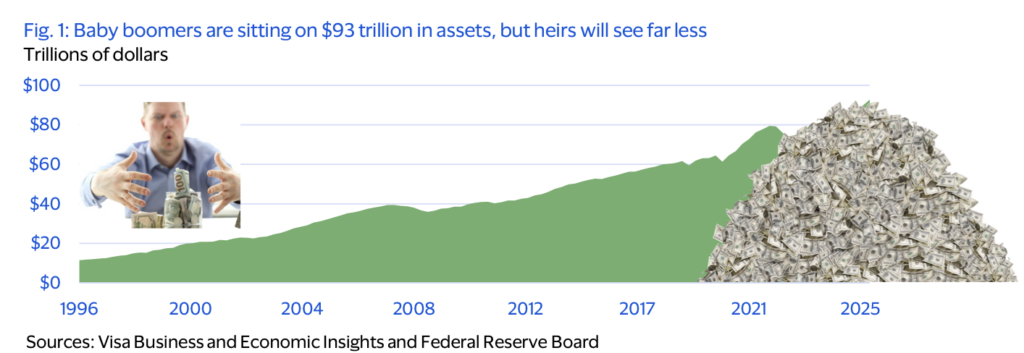
Visa’s analysis estimates baby boomers currently hold at least $93 trillion in assets — more than three times the roughly $31 trillion size of the U.S. economy in 2025 and more than the assets held by Gen X and millennials combined.
But Visa said the headline figure significantly overstates the amount that will ultimately reach heirs.
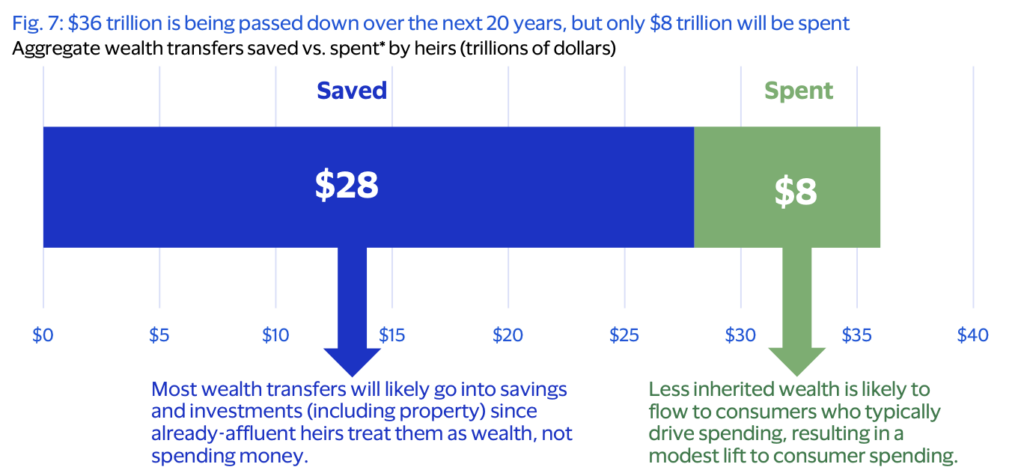
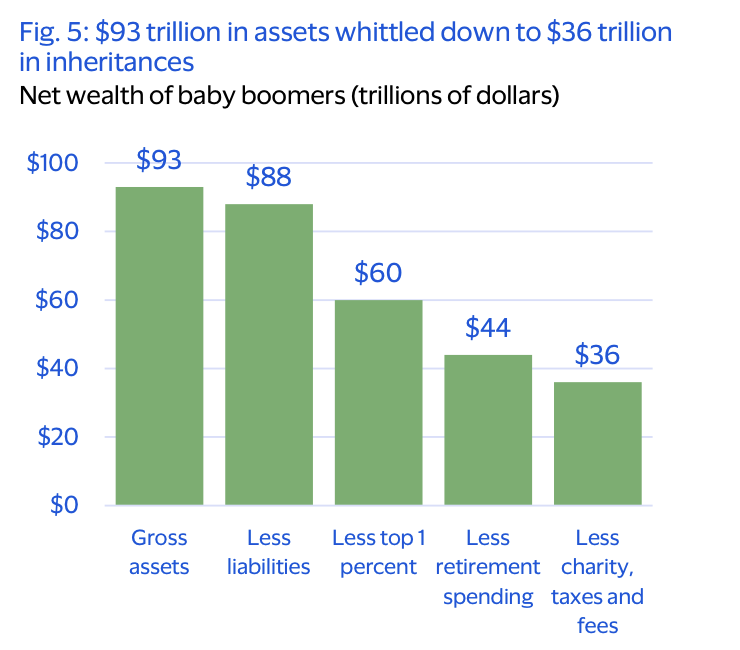
After accounting for liabilities, excluding wealth held by the top 1% of households and factoring in retirement spending, charitable giving, taxes and fees, Visa estimates about $36 trillion will be transferred to younger generations over the next two decades. That works out to approximately $515,000 per inheriting household.
The transfer will also be highly concentrated among households that are already financially well off.
$36 Trillion? Just $8 Trillion in Spending
Nearly 75% of those expected to benefit from the wealth transfer already have higher net worth, according to Visa. As a result, the company estimates only about $8 trillion of the $36 trillion will translate into additional consumer spending, while roughly $28 trillion will be saved or invested in such things as securities, property and other assets.
That could create significant opportunities for financial institutions, wealth managers and fintech companies seeking to retain assets as they move from one generation to another, Visa said.
Spending Impact Expected to Be Modest Overall
Even $8 trillion in additional spending spread across 20 years will not dramatically change the trajectory of the U.S. consumer economy, according to the report.
Visa projects real consumer spending will grow an average of 2% annually over the next two decades without the inheritance effect. Adding spending resulting from inherited wealth would increase that growth rate by about 0.1 percentage points, to 2.1%.
Visa characterized the transfer as an additional tailwind for consumer spending rather than a new engine of economic growth.
The impact, however, is expected to be considerably more noticeable in individual spending categories.
Visa identified several areas likely to receive some of the largest boosts from inherited wealth:
- Autos: 6.4% average annual inheritance-related spending lift.
- Housing: 4.6%.
- Travel: 3.2%.
- Retail: 3.1%.
- Dining out: 2.3%.
- Leisure: 1.7%.
- Other categories: 0.9%.
Vehicle purchases and related costs such as insurance, maintenance, repairs and gasoline are expected to receive the largest lift, Visa said.
Housing is another major area where inherited and transferred wealth could have an outsized effect. More than half of consumers expecting an inheritance said it is critical to their long-term financial security, including their ability to purchase a home. Among millennials, that figure rises to 69%.
Wealth Transfer Has Already Begun
Visa said the so-called Great Wealth Transfer should not be viewed solely as an inheritance event that will occur after baby boomers die.
Instead, a significant amount of wealth is already moving between generations as parents and grandparents provide financial assistance while they are alive.
One-in-four Millennial homeowners received down-payment assistance from their parents, according to research cited by Visa, while 26% said they would not have been able to purchase their current home when they did without that help.
Visa said such assistance can help younger buyers qualify for mortgages, reduce monthly payments or purchase more expensive homes.
The trend extends beyond housing.
Visa cited research showing 66% of boomers either want to enjoy their wealth themselves or want their heirs to enjoy it while they are still alive, compared with 34% who want to preserve their wealth for after their deaths.
Travel is one example. Twenty-eight percent of grandparents have taken grandchildren on trips without the children’s parents, while 35% plan to take such a “skip-generation” trip during the next three years.
Not All Boomers Are Wealthy
Visa also cautioned against interpreting the $93 trillion in baby boomer assets as evidence that all members of the generation are financially secure.
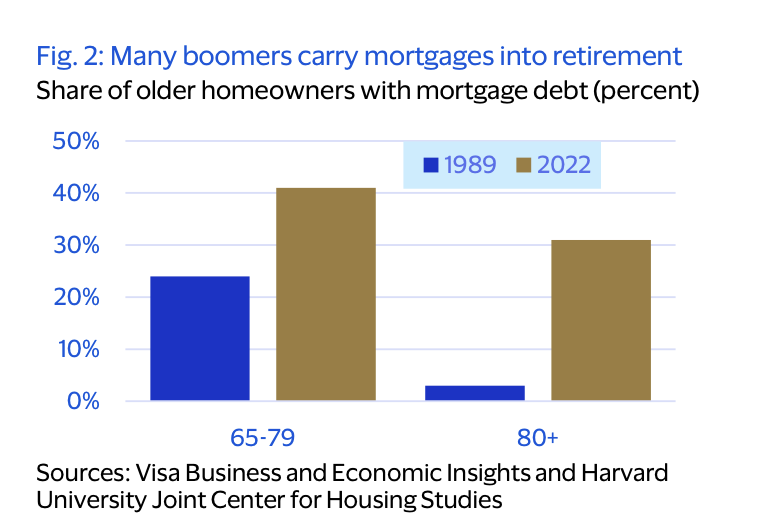
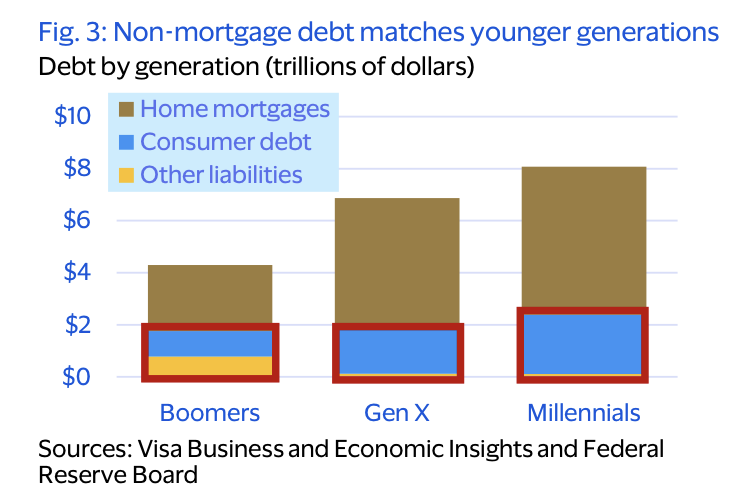
Boomers collectively carry more than $4 trillion in debt. Visa found 41% of homeowners ages 65 to 79 still have mortgage debt, as do 31% of homeowners 80 and older.
Nearly half of mortgage-holding households headed by someone 65 or older face moderate to severe housing cost burdens, meaning housing consumes at least 30% of their income.
Those obligations mean many lower-wealth boomers will need to spend a substantial portion of their assets on housing, food, health care, prescription drugs and other expenses during retirement rather than passing the money to their children.
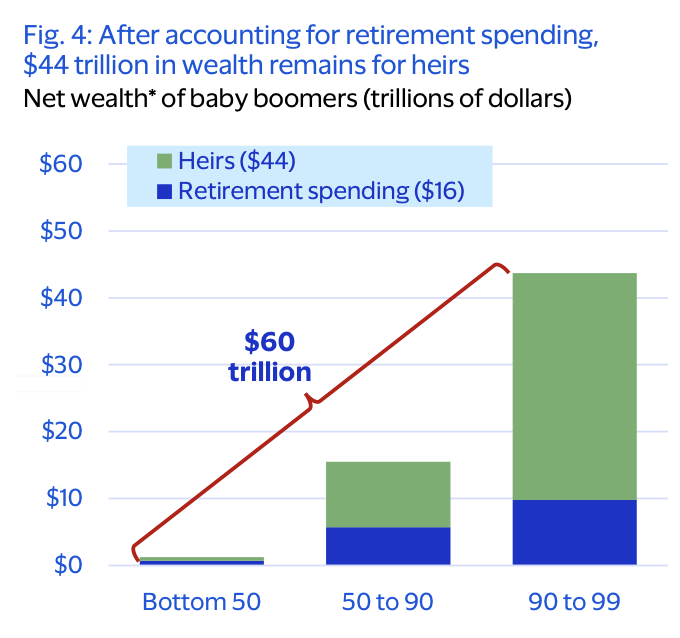
After subtracting liabilities from the $93 trillion in gross assets, Visa estimates boomers have about $88 trillion. Excluding the top 1% of households reduces the figure to $60 trillion.
Of that amount, about $44 trillion is held by boomers in the 90th through 99th wealth percentiles, while the bottom 90% collectively hold approximately $16 trillion.
Younger Generations Enter Transfer in Stronger Position
Visa also challenged the perception that Gen X and millennials are universally worse off financially than baby boomers were at comparable ages.
On an inflation-adjusted, per-person basis, Gen X and millennials have accumulated more wealth than boomers had at the same ages, according to Visa’s analysis.
The report attributed some of the difference to younger generations having earlier access to 401(k) retirement plans, automatic enrollment and low-cost digital investing, as well as the home-equity gains enjoyed by some homeowners who locked in historically low mortgage rates.
Visa said that stronger starting position helps explain why so much inherited wealth is expected to remain invested rather than immediately enter the economy.
Wealthier heirs are more likely to move inheritances into investment accounts, retirement savings, trusts and other long-term assets. Less-affluent recipients, meanwhile, are more likely to use inheritances relatively quickly to purchase homes, pay down debt, renovate properties, replace vehicles, travel or assist their own children.
‘Not a Future Trend to Watch’
“For businesses in big-ticket sectors like housing and travel, this is not a future trend to watch,” Visa Chief Economist Wayne Best said in announcing the research. “It is already influencing consumer decisions — and shaping where growth will be distributed in the years ahead.”
Visa Business and Economic Insights based its analysis on internal economic modeling and data from the Federal Reserve Board, Treasury Department and Labor Department, along with third-party consumer research.
The full Visa report can be found here.