
LAS VEGAS–It’s no secret there are some holes when it comes to credit union leaders’ understanding of emerging technologies and how to respond. Three people here offered some suggestions on how CU leader can, if not fill those holes, at least better understand where they are.
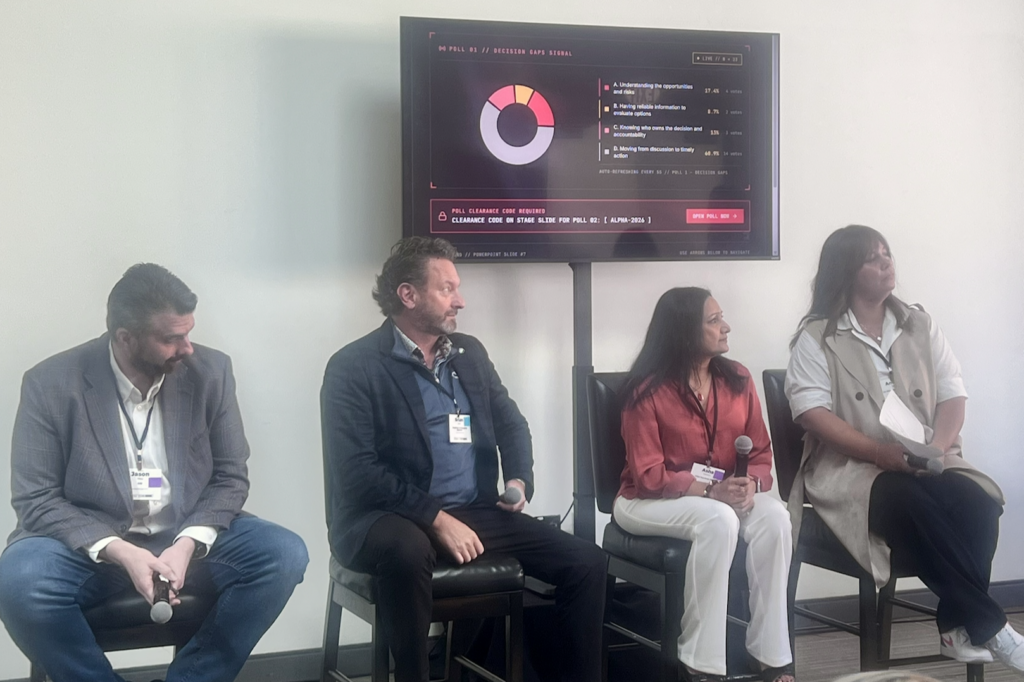
During a session titled, “The Judgement Gap: AI Stablecoins and Fraud” during Mitchell Stankovic’s Underground Reckoning event in Last Vegas, held in conjunction with Money 20/20, perspectives were shared on where technology has exposed a weakness in CUs, how to vet all the fintech options, and where it would be a huge victory if all credit unions would come together on one big use-case–even though they almost certainly will not.
Panelists in the discussion included:
- Jason Tilley, CIO, First Advantage CU
- Brian Kaas, president and managing director of TruStage Ventures
- Asha Connors, executive director of ProBridge
The discussion was moderated by Amber Harsin, VP of strategy and innovation for Curql. Here is some of what was shared:
Harsin: Where does faster technology expose a weakness in how we run a credit union?
Tilley: Governance. Technology is easy, it’s the governance and integrating it into systems and legacy platforms that are not up to the task. That’s the huge lift. We need to understand how to roll out technology in a regulatory compliant way that makes sense for our members. Throwing tech at a problem is never a solution. It’s about understanding the use-cases and how to navigate that properly.
Harsin: As someone who helps vet fintechs entering credit unions, how should leaders of CUs judge a new opportunity before they commit?
Kaas: The number of fintechs is 10,000 and growing, and with the use of AI I feel like it’s growing even faster. Where I tend to start is you have a number of funds that are investing, that are vetting a number of the solutions. Another really important thing is talking to the credit unions that fintechs partner with. That’s probably the greatest testament. Are they living up to and delivering what they say in a pitch? If they are serving customers and being honest with the customers, I think that’s critical.
Harsin: When we think about governance, capacity, vetting new ideas, what advice would you give back around the executing of readiness as we move into this new stage of AI? Many feel we are not quite ready.
Tilley: You really need to understand the need. We are not all the same. Different memberships at different credit unions have different needs. I love that there are 10,000 options to pick from, but not every product fits every need. The other part of this is I think we’re kidding ourselves around how well we understand our operations. I abhor applying technology on top of busted processes that were created in 1934. If a process is broken, you are just making it marginally faster.
Connors: I think AI really needs reliable data. How confident are you in your data? How up to date are your processes and systems? Before you bolt a product on your existing data, what are your data issues? If AI is going to decide for you, what are the consequences? What if AI decides wrong? Is it reversible? How will you mitigate it? AI is bright and shiny and here now, but at the end of the day AI works off of data and if your data is not ready for this major adventure, let’s clean up the data so all data is saying the same thing and it’s a cohesive data ecosystem.
Harsin: The speed and capabilities of fraud are increasing. What changes need to be put in place in the credit union and community banking industry to keep up?
Connors: We talk about ID and authentication. We ask the question, is this the person they say they are? But you can’t stop there. You have to ask, ‘Is this behavior what we expect of this member?’ Multi-factor is great, but the next step is the pattern and the behavior. Is it out of character? You have to be able to pick that up in real time and stop that transaction.
Harsin: What do you believe credit unions need to test and build together?
Tilley: I think identity, if we can solve that and figure that out as community banks and credit unions together and can build some sovereign identity blockchain, then moving a lot of this stablecoin, payments or Reg E challenges (will be considerably easier).
Kaas: The power of credit unions is collaboration, but the challenge I’ve seen is they tend to move incredibly slow at a time when things are moving faster than ever. It would take us 24 months to agree on the name of the initiative. But we have to get better at collaborating behind different technologies. On fraud, how do we create a repository of information that could be shared among credit unions at the same time? I think stablecoin is another example where things are going to move very quickly. We have to get behind a solution and move quickly to really challenge the power of the industry as a whole.