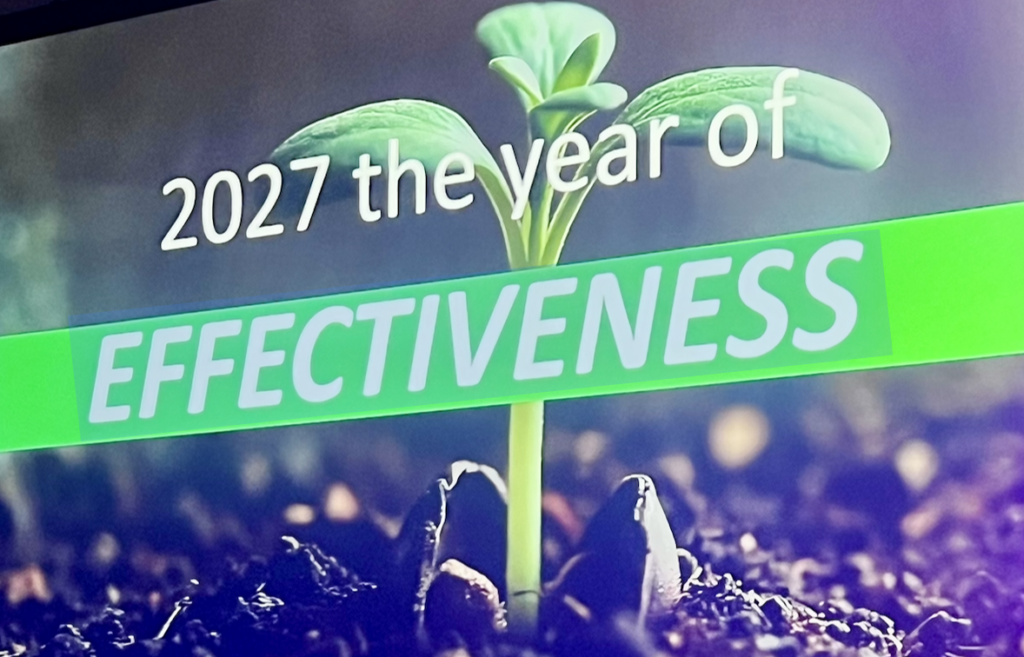
PALM DESERT, Calif.–Credit unions focused on becoming more efficient may in fact be wasting time and resources in that pursuit—ironically becoming more inefficient—while underutilizing a free asset that can give the CU a “ton of extra rocket fuel,” according to one person, who offered strategies for turning 2027 into the “Year of Effectiveness.”
In remarks around the democratization of innovation, Dr. Simone Ahuja told the California and Nevada leagues’ REACH Conference that simplicity and small consistent changes can lead to winning, especially in complex environments and scenarios. In solving problems, Ahuja said the question most organizations forget to ask is, “What is needed?”

“(Organizations) make assumptions and make things complicated when they don’t have to be, and the real need gets overlooked,” said Ahuja, the author of “Jugaad Innovation,” and other books, “We spend time chasing down the problem that doesn’t really have value. So how do we create more value through simplicity and ingenuity. When we get more clear about each other, our needs, our members, that’s when we start to have a catalytic effect.
“I get why this is so hard to ask,” Ahuja continued. “We’re all so busy we don’t have time to pause and think about our strategy sometimes. Everyone is facing pressure to grow and stay competitive while facing complexity.”
The Year of Efficiency
Ahuja noted that Meta’s Mark Zuckerberg said in 2023 that it would be the “year of efficiency.” And that rolled into 2024, 2025 and this year, “and that squeeze created some challenges for learning, impact and morale.”
But pure efficiencies aren’t enough, according Ahuja.
“Efficiency is great, but efficiently is doing things right,” Ahuja clarified. “What I want you to think about is effectiveness. Effectiveness is doing the right things. I propose we call 2027 the Year of Effectiveness.”
So, how does an organization know what’s effective?
Ahuja said shifting to more impact though simplicity requires three things:
- Seeing boundaries as catalysts
- Solving the right problem
- Simplifying to amplify impact.
And to accomplish that, it requires three shifts, according to Ahuja:
Shift One: Mindset
Ahuja urged credit union leaders to reframe boundaries as catalysts for creativity and clarity, saying that clear boundaries help people and organizations to focus on what matters most and to ask, “What is the simplest way we can make progress?”
This can be about doing better with less, a challenge Ahuja has studied extensively in India, where she learned the term, “Jugaad.” The original meaning was to about a jury-rigged farm vehicle that is hacked together from a mish-mash of parts. It has since been expanded to cover much broader applications.
“Jugaad is optimistic,” said Ahuja. “What I love about Jugaad is, ‘There is always a way.’ It’s not about your role or title; it’s about your mindset to better solve problems.”
As an example, Ahuja shared a picture of a person in India who used a pair of pants to direct cold air from an air conditioner into two separate rooms.
“It’s our mindset,” she told the meeting. “When we think differently, we act differently. You can scale in large organizations. Regulation doesn’t mean you can’t apply this mindset.”
Shift Two: Skillset
This is about solving the right problem, not just the obvious one, she said, and that means not the problem that’s at the surface or the assumptions have been made about.
“It’s really hard when you’re experienced, because we risk solving the wrong problem. So, let’s ask, what do they need?
Ahuja shared what she called a “secret weapon,” of innovation, or a simple framework to assess needs. She broke that down as:
- Functional (do)
- Emotional (feel)
- Social (be seen). “This piece is very difficult to get to, but when we get there is where we get some of the best innovation. This is about how does someone want to be perceived and seen. Imagine a member in your credit union asking about a loan after a car repair. Their functional need is they need transportation to and from work. The emotional need is ‘I need to feel confident I can repay this loan in a way that is comfortable.’ The social need is, ‘I need to be seen as competent.’”
How to Put Into Action?
How does a leader put all of this into action?
“Make it simpler for your members,” advised Ahuja. “Voices are often not being heard, or being invited to share what they need. Ask them where they are getting confused. If you are a new or emerging leader, you do not need to be CEO to identify a problem. You have already seen them. You should bring your manager a specific issue and bring a solution. Make it a light lift for your manager. That’s your purpose and practice: Make it easier for members to get the help they need.”
As an aside, Ahuja pointed out that beyond salary, research shows in credit unions young leaders say they stay in their jobs because of who is their manager and what that relationship is like, along with opportunities to grow and feel valued, which can be found in a purpose-driven industry.
“If you are leading a team, ask them, ‘What makes you want to stay?’”
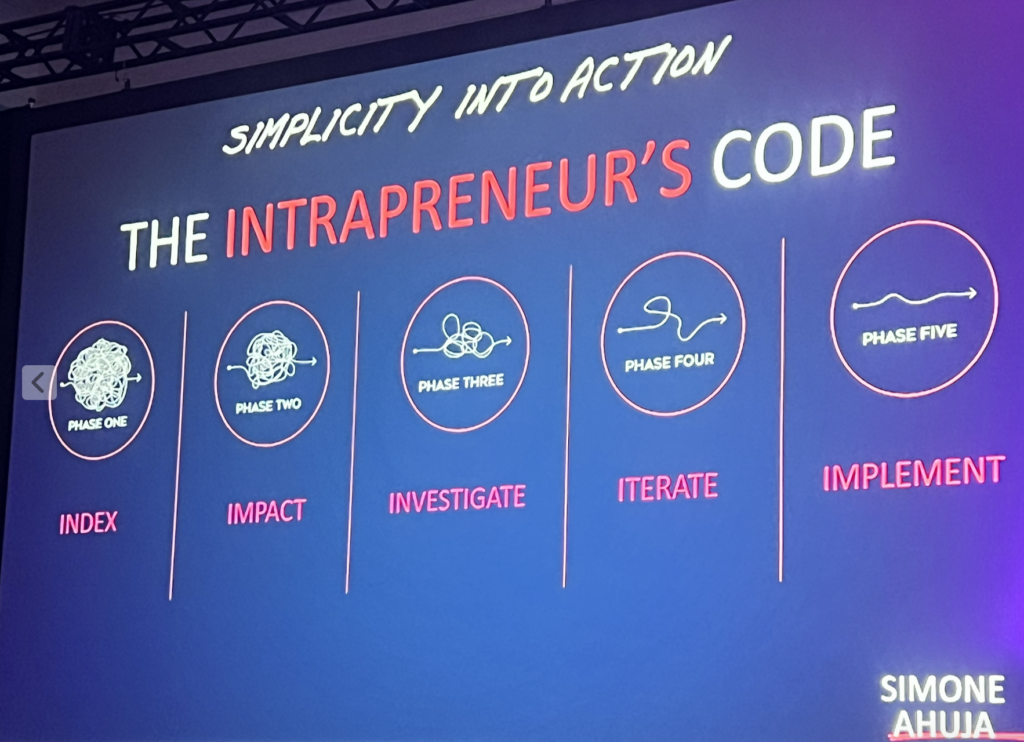
Ahuja outlined what she calls “The Intrapreneurs Code.”
Shift 3: Simply to Amplify Impact
Ahuja said one thing that surprised her in established organizations is how many people feel they are falling behind, and the reason is that they have too many priorities.
“People cannot guess what comes first; it has to be super-clear,” said Ahuja. “Focus like you mean it. If the connection isn’t clear, don’t do it. Or, at least pause.”
Ahuja recommended using the filter of “impact, ease, interest” to determine what matters most.
“If our people are deeply interested in something, it gives them a ton of extra rocket fuel,” said Ahuja, saying early in her career she discounted the value of “interest.”