
WASHINGTON—America’s Credit Unions is questioning whether the National Credit Union Administration is significantly underestimating the time credit unions spend complying with anti-money laundering requirements, arguing the agency’s assumptions fail to account for differences in institutional size, complexity and risk.
In an Oct. 21 letter to the NCUA, the trade association called on the agency to provide additional justification for its estimate that federally insured credit unions spend just eight hours annually maintaining and documenting their anti-money laundering and countering the financing of terrorism (AML/CFT) programs.

The association also urged the NCUA to support broader modernization of Bank Secrecy Act (BSA) requirements, including substantially increasing the dollar thresholds that trigger mandatory reporting of certain financial transactions.
The letter was submitted by Luke Martone, regulatory advocacy senior counsel for America’s Credit Unions, in response to the NCUA’s proposed renewal and revision of an information collection under the Paperwork Reduction Act.
NCUA Estimates 80,856 Hours of Compliance Work
According to America’s Credit Unions, the NCUA estimates that 4,331 federally insured credit unions will incur a combined 80,856 annual burden hours associated with AML/CFT program recordkeeping.
The agency’s supporting documentation divides the estimate into two components:
- Program establishment: 32 hours per credit union, representing an estimated annualized burden of 46,208 hours.
- Ongoing maintenance: Eight hours annually per credit union, representing 34,648 hours.
- Total estimated annual burden: 80,856 hours.
The NCUA said its estimates were adjusted to distinguish between one-time and ongoing compliance burdens.
America’s Credit Unions noted the eight-hour annual estimate originated in a 2024 federal regulatory proposal and was based on what regulators described as supervisory experience.
That estimate includes recordkeeping associated with documenting policy revisions, periodic reviews of risk assessments, independent testing, compliance training and board oversight.
It also assumes each institution annually reviews its AML/CFT program and submits a revised plan to its board for approval.
Association Questions One-Size-Fits-All Approach
America’s Credit Unions argued the NCUA has not adequately demonstrated that eight hours is a reasonable estimate for institutions of widely varying sizes and risk profiles.
The association asked the agency to explain whether its estimate is supported by actual information collected from federally insured credit unions.
It also questioned the assumption that recordkeeping requirements are unaffected by institutional size.
“Credit unions differ significantly in size, staffing, complexity, transaction volume, and AML/CFT risk, all of which can affect the work required to maintain and document an effective program,” the association stated.
The letter emphasized that smaller credit unions often have limited staffing and resources, making accurate assessments of regulatory burdens particularly important.
Survey Shows Substantial Reporting Burdens
To support its concerns, America’s Credit Unions cited results from a recent survey of member institutions examining the time required to prepare and file Suspicious Activity Reports (SARs) and Currency Transaction Reports (CTRs).
The survey found substantial differences in reporting volumes between small and large credit unions, a cccording to the trade group.
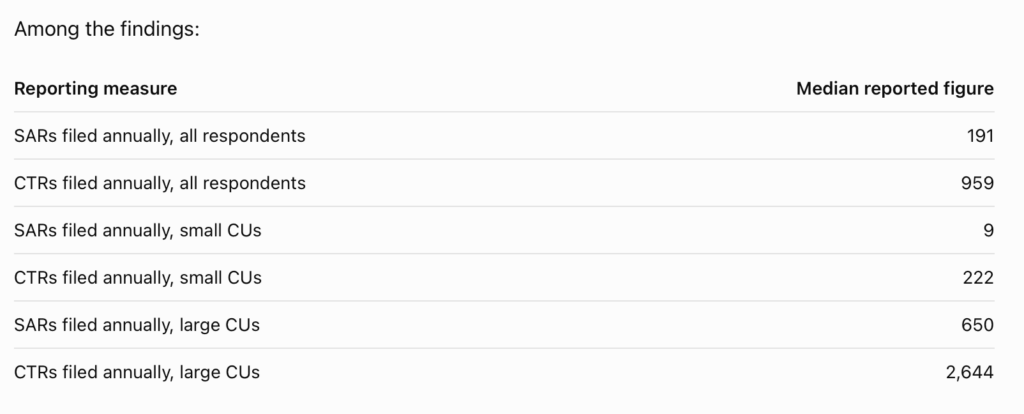
The survey also found that credit unions reported spending a median of 90 minutes preparing each SAR and 20 minutes preparing each CTR, America’s Credit Unions said.
The association noted the 20-minute CTR completion time is 2.5 times the eight-minute estimate used by the Financial Crimes Enforcement Network (FinCEN).
Based on individual institutions’ reported filing volumes and completion times, the survey calculated the following median annual workloads:
- SAR filings: 364.9 hours.
- CTR filings: 369.5 hours.
Together, those figures illustrate the hundreds of hours credit unions may devote annually to financial crime reporting requirements.
America’s Credit Unions acknowledged that SAR and CTR filings are covered by separate FinCEN information collections and are not included in the NCUA’s eight-hour maintenance estimate.
As a result, the association said, the survey’s reporting hours should not simply be added to the NCUA’s estimate.
However, it argued the findings demonstrate the significant differences in AML/CFT workloads among credit unions and support a more detailed review of the agency’s methodology.
Calls for Higher SAR, CTR Reporting Thresholds
Beyond questioning the NCUA’s recordkeeping estimates, America’s Credit Unions reiterated its support for broader changes to federal anti-money laundering requirements.
The association said it has separately urged FinCEN to increase reporting thresholds that have not kept pace with inflation and changing financial activity.
Its recommendations include:
- Currency Transaction Reports: Increase the reporting threshold from $10,000 to at least $30,000, with future adjustments for inflation.
- Suspicious Activity Reports: Increase the reporting threshold from $5,000 to at least $10,000.
- Reporting forms: Simplify SAR and CTR forms and filing processes to reduce unnecessary administrative work.
- Regulatory expectations: Tailor AML/CFT requirements and supervisory expectations to each institution’s size, complexity and risk profile.
America’s Credit Unions asked the NCUA to support those changes in its discussions with FinCEN and other federal regulators.
Focus on Risk-Based Compliance
The association emphasized that it supports effective anti-money laundering programs but believes compliance resources should be directed toward identifying and addressing meaningful financial crime risks rather than unnecessary paperwork.
It urged the NCUA to gather additional information directly from credit unions before finalizing its burden estimates.
“An accurate burden estimate will help ensure the PRA analysis reflects the actual impact on credit unions,” Martone wrote.
The association said it looks forward to working with the NCUA and FinCEN to develop a more effective, risk-based AML/CFT framework that maintains financial crime safeguards while reducing unnecessary regulatory burdens.