

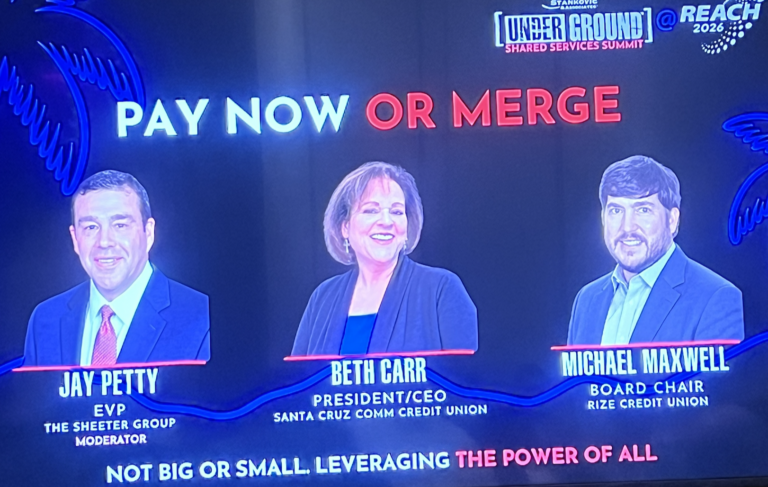
PALM DESERT, Calif.–The touchy question of adequately compensating the CEO and senior executives—or risk having them depart and perhaps ultimately contributing to a merger—was discussed by one CEO and one chairman here.
During a session titled “Pay Now or Merge: The Realities of Compensation” during Mitchell Stankovic’s
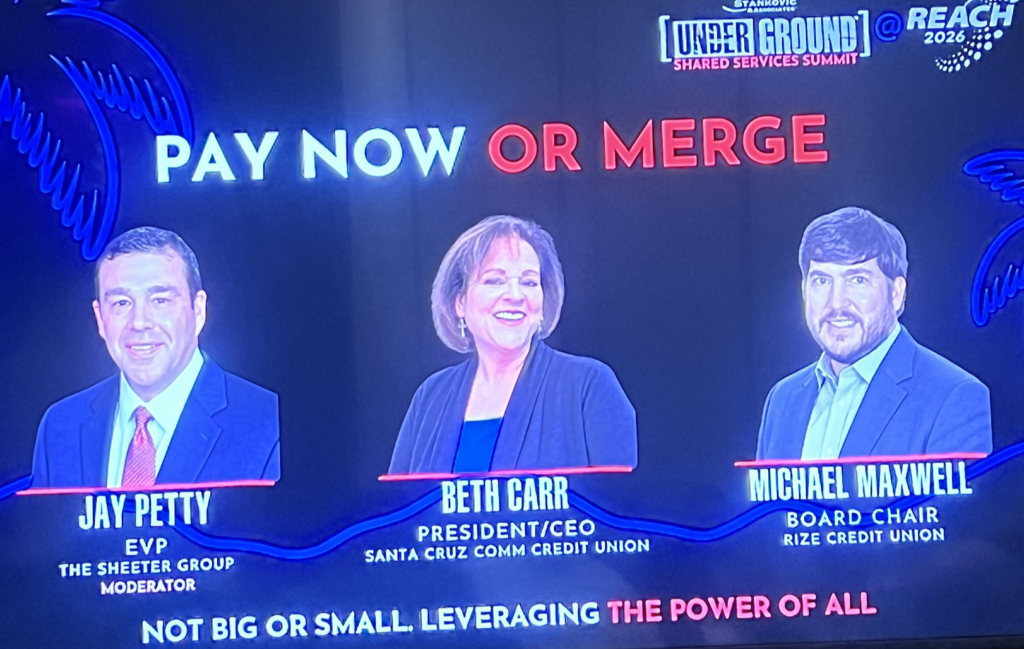
Participating as panelists were:
- Beth Carr, president and CEO, Santa Cruz Community Credit Union
- Michael Maxwell, board chair, Rize Credit Union
Moderating the session was Jay Petty, EVP with the Sheeter Group.
Rize CU has about $1 billion in assets, is located in Southern California and is moving to a community charter. California-based Santa Cruz Community Credit Union is a CDFI with a three-county FOM and three branches. It has a focus on helping struggling communities and low-income residents, many of whom speak Native-American languages.
Petty: The topic is pay now, or merge. You had better take executive compensation seriously, or you run the risk of being merged. I have seen this in working with CUs on SERPs. When a credit union neglects to pay a competitive compensation, it leads to turnover, and that can be particularly disruptive to a credit union. The credit union can strategically flatline. And if the new CEO doesn’t work out and they are gone within the year, you are looking at years of flatlining.
I have seen a new emphasis on organization and workplace cultures. But when a CEO isn’t paid a competitive package, it can be a morale issue, and you can see that creep into the organization.
And then I’ve seen sticker shock. When there is a retirement or departure, the board can very quickly get sticker shock.
What are you doing to ensure you have a competitive CEO compensation package?
Maxwell: We have a compensation committee, and we do comparisons. We look at all the numbers. It can be kind of hard for us to judge. Most importantly, we have an open dialogue about what they expect, because the CEO is our one employee. And we want everyone at the credit union to feel valued.
Petty: What do you see to ensure you as the CEO is compensated fairly?
Carr: When I first came to the credit union they had fired a CEO, rehired the same CEO, and then she quit. They then hired a temporary CEO who went to Hawaii for two months, then a CEO was brought in by NCUA, and then I was brought in. The credit union also got a TARP loan from the government. So, it was a little bit crazy. With the TARP we could not do an executive compensation plan. It took us about seven years to get it paid off.
After a few years, as we got things cleaned up, I said, ‘I think we need to look at the salary.’ When the original salary was offered, I said ‘no.’ It was a lot of work. The credit union was started by an activist group, and they looked at the credit union like any nonprofit. The board turned over frequently, and many had only a $5 savings account with the credit union. The education was a big lift, and I said, ‘You need to do a little bit more.’ It took a couple of years to get it done. The discussion about a retirement package would never have happened had I not called Sue (Mitchell). Our board was pretty uneducated around compensation.
Petty: What challenges, barriers to you face?
Maxwell: In general, attracting talent into this industry is a challenge. We might be paying slightly more than market to really make sure the CEO is driving the organization forward. And as a board we want to make sure we are getting that value from the CEO. Conversely, some challenges are that some board members are auditors or CPAs asking why we are doing that, and others balance that out by saying we need to do right by this person. We are patient about it and have multiple voices
Carr: There are several challenges. One is that our area is a top three (expensive) place to live. It’s hard to have people move in and think they can find a place to buy or rent. That does keep people from coming in.
The other is board pushback on compensation.