


MIAMI, Fla. — Where Americans live may play a significant role in how happy they are, with a new WalletHub analysis finding that financial security is only one part of an equation that also includes physical and mental health, relationships, employment, leisure time and community connections.
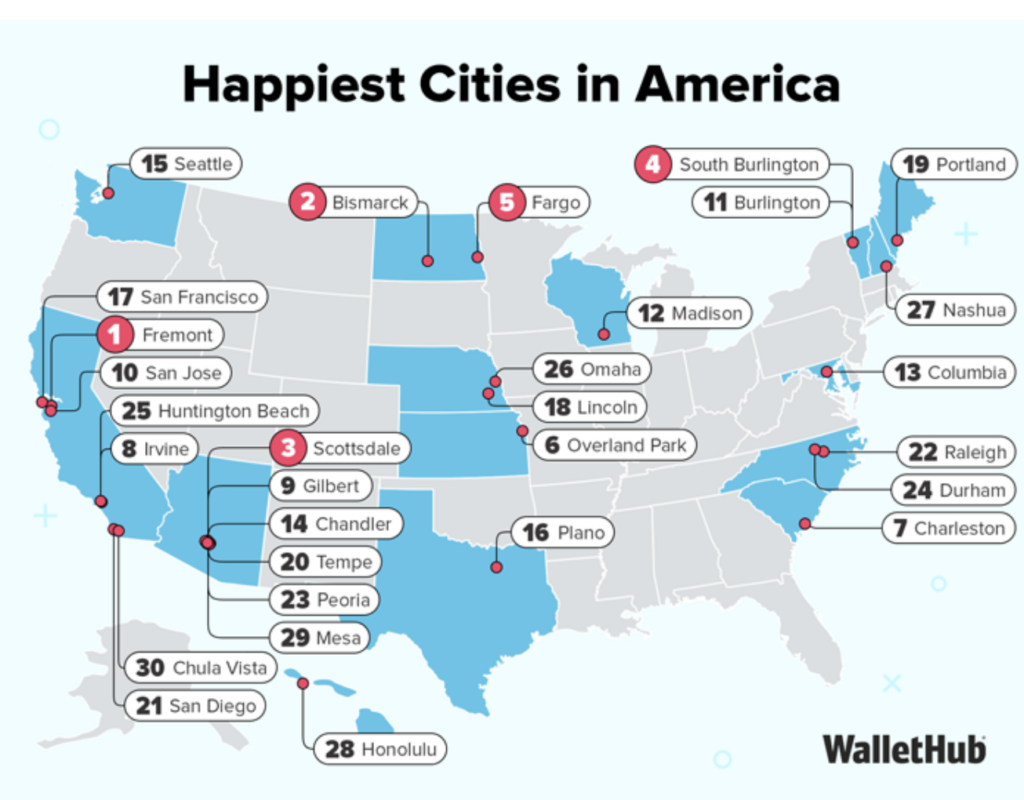
Fremont, California, ranked as the happiest city in the country, followed by Bismarck, North Dakota, and Scottsdale, Arizona, according to WalletHub.
The personal finance company compared 182 of the nation’s largest cities across 29 measures of happiness, ranging from depression and adequate sleep to income growth, work hours, commute times and leisure time.
WalletHub said decades of research into happiness have identified several important factors, including mental well-being, physical health, strong social relationships, job satisfaction and financial stability.’
Money Helps, But…
Money can help, but WalletHub cited research indicating the benefit has limits. One widely cited study found that earning more than $75,000 annually did not produce additional gains in day-to-day emotional well-being.
The analysis noted that the United States, despite being among the world’s wealthiest countries, ranks No. 24 in the World Happiness Report.
“Research shows that having more money only increases your happiness until you’re making at least $75,000 per year — anything more you earn likely won’t have an impact,” WalletHub said. “Therefore, when deciding where to live to maximize your happiness, you’ll want to pick a city that offers more than just a decent average income.”
WalletHub said the ideal city also offers conditions conducive to good physical and mental health, including reasonable work hours, short commutes, favorable weather and caring neighbors.
Fremont Takes No. 1 Spot
Fremont topped WalletHub’s rankings in part because nearly 80% of its households have annual incomes above $75,000, the highest percentage among the cities studied.
But income was far from the only factor.
Fremont also had the highest life-satisfaction rate, the seventh-lowest depression rate and fifth-highest average life expectancy in the country, according to WalletHub.
The California city had the nation’s lowest separation and divorce rate at 9.3% and the lowest percentage of adults reporting 14 or more mentally unhealthy days during the previous month.
Fremont also ranked fifth in WalletHub’s separate analysis of the country’s most caring cities, another factor the company said can contribute to residents’ overall happiness.
Bismarck Combines Health, Community and Leisure
Bismarck ranked second nationally, aided by measures of health, sleep, community satisfaction and leisure time.
The North Dakota capital had the ninth-highest percentage of adults reporting good or better health and the 13th-lowest percentage of residents getting fewer than seven hours of sleep per night.
Bismarck also ranked seventh on Sharecare’s Community Well-Being Index, which measures factors including whether residents like where they live, feel safe and take pride in their community.
The city also recorded the highest average amount of daily leisure time among the cities examined by WalletHub, giving residents more time for family, recreation and personal interests.
Scottsdale Ranks Third
Scottsdale ranked third, with physical and mental health helping drive its performance.
More than 88% of Scottsdale adults reported being in good or better health, the third-highest percentage nationally, while nearly 87% participated in physical activities.
Scottsdale also had the third-lowest percentage of adults reporting 14 or more mentally unhealthy days per month.
Financial conditions were another positive factor. About 65% of Scottsdale households earn more than $75,000 annually, while 7% of residents reported incomes below the poverty level during the previous 12 months.
Top 10 Happiest Cities
WalletHub’s 10 highest-ranked cities were:
- Fremont, California.
- Bismarck, North Dakota.
- Scottsdale, Arizona.
- South Burlington, Vermont.
- Fargo, North Dakota.
- Overland Park, Kansas.
- Charleston, South Carolina.
- Irvine, California.
- Gilbert, Arizona.
- San Jose, California.
California, North Dakota and Arizona each placed two cities in the top 10.
How WalletHub Measured Happiness
WalletHub compared 182 cities, consisting of the 150 most populous U.S. cities plus at least two of the most populous cities in each state.
The company grouped 29 metrics into three broad categories:
- Emotional and Physical Well-Being — 50 points: Measures included life satisfaction, depression, suicide, adequate sleep, physical health, sports participation, marijuana use, opioid prescriptions, mental health, life expectancy and food insecurity.
- Income and Employment — 25 points: Measures included income growth, households earning more than $75,000, poverty, job satisfaction and opportunities, job security, unemployment, underemployment, bankruptcy, weekly work hours and commute times.
- Community and Environment — 25 points: Measures included WalletHub’s Most Caring Cities ranking, separation and divorce rates, hate crimes, weather, parkland, leisure time and Sharecare’s Community Well-Being Index.
Depression, adequate sleep, physical health, sports participation, poor mental health and food insecurity received double weight within the emotional and physical well-being category.

Income growth, unemployment, underemployment, bankruptcy and weekly work hours received double weight in the income and employment category.
Daily leisure time received double weight in the community and environment category.
Each measure was graded on a 100-point scale, with 100 representing maximum happiness. WalletHub then calculated weighted averages to produce the overall rankings. Some measures, including average daily leisure time, were available only at the state level.
Research Behind the Rankings
WalletHub said its methodology draws on academic research that has found relationships between happiness and health, longevity, experiences and sports participation.
Among the research cited were “Happy People Live Longer: Subjective Well-Being Contributes to Health and Longevity,” by Chan and Diener; “Happiness from Ordinary and Extraordinary Experiences,” by Bhattacharjee and Mogilner; “Sports Participation and Happiness: Evidence from U.S. Micro Data,” by Huang and Humphreys; and “Unhappy Cities,” by Glaeser and other researchers.
WalletHub also assembled a panel of experts to examine broader questions surrounding happiness, including what people can do when dissatisfied with their careers, whether happiness changes with age, how much location influences well-being, whether money can buy happiness and how a city’s overall economic climate affects individual happiness.




