
NEW YORK — MSUFCU has joined with three major philanthropic foundations to introduce a credit union named Artichoke designed specifically around the financial needs of people with disabilities, their families, caregivers and advocates. Here’s why.
As the CU Daily first reported here, the Ford Foundation, John D. and Catherine T. MacArthur Foundation and Robert Wood Johnson Foundation announced the initiative in partnership with the $8.7-billion Michigan State University Federal Credit Union in East Lansing, Mich.

Artichoke Credit Union will operate as a trade name and sub-brand of MSUFCU rather than as a separately chartered credit union, the organizations said. It is expected to begin accepting members early in the second quarter of 2027. MSUFCU operates several sub-brand credit unions, including AlumniFi and Collegiate.
The organizations described Artichoke as the first credit union initiative of its kind, designed specifically with the disability community at the center of its products, services and accessibility features.
At launch, Artichoke is expected to offer checking and savings accounts, certificates, personal loans, credit and debit cards, budgeting tools and financial education resources.
Members also are expected to have access to live chat, telephone and video support, along with accessibility-focused features including account alerts, guardian access options and other tools developed around the needs of members.
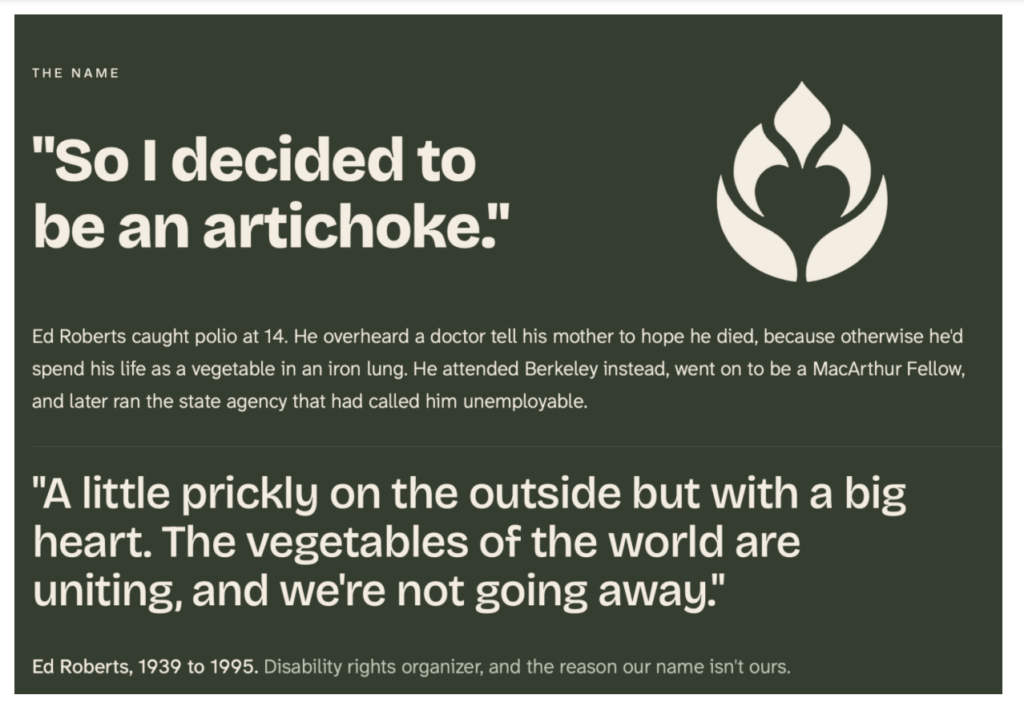
A $5 membership share will establish membership in the credit union. According to its website, the name for the credit union is explained below.
Seeking to Make Financial Services More Accessible
April Clobes, president and CEO of MSUFCU, said the initiative builds on the credit union’s previous work to improve accessibility, including accessible ATMs, accessibility-focused lending programs and investments in financial technology.
She added MSUFCU intends to use the initiative to further the credit union movement’s goal of making financial services more accessible and inclusive.
Below, Rebecca Cokley, director, U.S. disability rights with the Ford Foundation, and Ami Iceman, chief experience officer with MSUFCU, offer CU Daily readers additional insights on how Artichoke Credit Union came to be and more.
The CU Daily: How did this idea/concept come about? Did the idea originate with the credit union?
Cokley: It was another financial institution’s commercial that motivated me to create something different. Two busy white, apparently non-disabled, suburban parents were standing on their carefully manicured lawn talking about how they needed to go to the bank because they were planning for their adult son with Down Syndrome’s future. They weren’t asking him about his future. He wasn’t going with them to the bank. And, both as a parent of disabled children and as a disabled woman, I wondered who was talking to him about his money. Where did he want to spend it? Was there something he specifically wanted to save for?
In partnership with Ford’s Mission Investments Team, we engaged the Financial Health Network (FHN), a leading authority on financial health, to conduct an in-depth landscape analysis to identify priorities, pain points, and gaps in financial services for people with disabilities.
The research conducted by FHN found that the disability community faces numerous obstacles to financial inclusion, including banking services that fail to meet the needs of disabled people, high fees, limited access to low-cost credit, challenging asset limits, and low awareness in the financial sector of tools such as ABLE accounts. FHN’s research also found a lack of awareness of the diverse experiences and needs of people with disabilities and that most financial institutions are not courting the disability community as customers.
FHN completed a feasibility study to assess viable pathways for launching a disability-first financial services solution and engaged an Advisory Board of people with disabilities and experts in the field to inform the path forward.
Launching as a ‘sub-brand’ of an existing credit union presented the ideal balance of factors including affordability, cost, risk, time to market, and most importantly–customizability and accessibility for the community.
The CU Daily: How long has this initiative been in the works?
Cokley: We’ve been working on it for the past three years. I came to Ford in 2021 and we established economic inequality as a core part of our strategic focus for our grantmaking. Supporting organizations working to eliminate the subminimum wage, raise asset limits, and shift the systems that keep disabled people poor really showed us how much more is needed in the space.
The CU Daily: How large is the potential community of people to whom this credit union might appeal?
Cokley: There are roughly 60 million disabled people in the United States. One-in-three households include a person with a disability. This is a population that is always growing and shifting. Do we think we can get to all 60 million, and their families? Likely not, but Artichoke can drive conversation on the issues facing people with disabilities and access to the financial sector.
We know how concerned many families are about ensuring their loved ones have the resources they need to live at home with the support they need. Artichoke is here for them. Every state has disability infrastructure, organizations including centers for independent living, parent/family training and information centers, developmental disability councils, protection and advocacy organizations—Artichoke is there for their banking needs, too.
Iceman: We view the opportunity as much broader than a traditional membership count. While the disability community itself is one of the largest underserved populations in the country, every individual is connected to a larger network of family members, caregivers, guardians, advocates, support organizations, and service providers.
Our goal is not simply about membership numbers. It is to help create a more accessible and inclusive financial ecosystem. If we build products, services, and experiences that work better for people who have historically faced barriers, we believe the benefits will extend far beyond the disability community and help shape a better banking experience for everyone.
The CU Daily: What specific needs do those with disabilities have that are not being met by current financial services providers?
Cokley: People with disabilities share experiences of disrespect and even outright discrimination when it comes to accessing and managing their finances. Most financial institutions are more comfortable talking to the non-disabled people in the lives of disabled people instead of seeing them as the untapped market that they are.
Where there are services available, complicated eligibility requirements, limited access to low-cost credit are common, and there is a low awareness of tools like ABLE accounts, or special needs trusts which allow people with disabilities to save money without affecting their access to healthcare or nutrition support.
People with disabilities also confront higher living expenses, barriers to employment, and imposed asset limits. Research found that only 10% of working-age people with disabilities are considered financially healthy, and households with a disability may require significantly more income to achieve the same standard of living.
Artichoke Credit Union is designed to help address these challenges through accessible banking, financial education, responsible lending, inclusive product design, and tools that support long-term financial well-being.
The CU Daily: Retail providers of all kinds often speak of addressing ‘pain points.’ Were there specific pain points these consumers pointed to?
Cokley: The study conducted by Ford and FHN found persistent gaps in financial inclusion. Nearly 30% of people with disabilities are unbanked or underbanked, compared to 17% of nondisabled people. Among unbanked individuals with disabilities, lack of trust in financial institutions is a top reason.
Other reasons for being unbanked include lack of trust in banks, high or unpredictable fees, or problems with banking or credit history.
The CU Daily: Were there any focus groups or research done that involved people with disabilities in order to better understand what they are seeking and the obstacles they encounter?
Cokley: Artichoke, as a credit union, is member owned, so unlike a regular bank, this will be an entity owned by people with disabilities, their families, and the organizations that support and serve them.
Our partner, the Financial Health Network, published a report with the National Disability Institute, a Ford Foundation grantee, focused on the financial health of people with disabilities. This research helped lay the foundation for the needs assessment and feasibility study they conducted as we began our work.
Michigan State University Federal Credit Union has had people with disabilities on their board for years and employed people with disabilities before the creation of Artichoke. Their other sub-brands have served students with disabilities and alumni with disabilities for years. Your average financial institution is not being advised by people who have had to navigate asset limits, eligibility requirements for health care, or endless bureaucracies. Artichoke is informed by those experiences and people with those lived experiences will be at the table.
The CU Daily: Are there specific products, particularly loan products or loan terms, that will be tailored to people with disabilities?
Iceman: While research and community input will ultimately guide product development, we anticipate exploring solutions designed around real-life needs, such as home modification loans, mobility device financing, accessible savings options, and other products that can help support independence and financial well-being.
We are also interested in exploring the use of alternative data and more inclusive underwriting approaches to better understand an individual’s financial capacity, particularly for those whose credit profiles may not fully reflect their circumstances.
Beyond products, we see a significant opportunity to provide education and guidance around topics that are unique to the disability community, including SSI asset and balance limits, ABLE accounts, public benefits navigation, special needs planning, caregiving-related financial considerations, and strategies for building financial security without unintentionally impacting eligibility for important support programs.
Our goal is not only to provide financial products, but to help individuals and families make informed decisions and navigate a financial system that can often be complex and difficult to understand.
The CU Daily: This is a digital-first credit union: How will the digital interface be tailored to meet the needs/requirements of this potential membership? Such as for those who are sight-impaired, for instance?
Iceman: We know accessibility isn’t one-size-fits-all, so our approach will be rooted in ongoing listening, research, and co-creation with people who have lived experience, our advisory board, advocates, caregivers, and experts.
As a digital-first credit union, we’ll provide multiple ways for people to engage with us, whether that’s through a mobile device, online, over the phone, by video, through chat, or with a virtual assistant. The goal is to give people options and let them choose the experience that works best for them.
We’ll also focus on the details that can make a big difference, things like supporting screen readers and assistive technology, allowing font sizes to scale, ensuring color contrast meets or exceeds accessibility standards, simplifying language, rethinking how questions are asked, and giving people more time to complete tasks when needed.
Most importantly, we don’t see accessibility as a project with a finish line. We’ll continue working with the community, our advisory board, and research partners to better understand what creates friction, confusion, or barriers to access, and then use those insights to continuously improve the experience.
If we’re successful, people won’t have to adapt to our financial experience. We’ll adapt the experience to better meet their needs.
The CU Daily: What has been the role of the Ford Foundation in this initiative?
Cokley: Ford has played a significant role as a convener for philanthropy’s engagement with the disability community for the last several years. From co-founding the President’s Council on Disability Inclusion in Philanthropy in 2019 to establishing our own standalone funding stream, we believe in taking bold steps to drive needed change.
But we don’t believe in doing this work alone. Ford presented the idea of Artichoke to the members of the President’s Council as an opportunity to collaborate and both the MacArthur Foundation and Robert Wood Johnson Foundation were eager to do so.
The CU Daily: Is the Foundation providing funding to this initiative in some way?
Cokley: The three foundations are each making a grant and a Program Related Investment (PRI) to MSUFCU in the form of a subordinated loan.
The CU Daily: How will word of Artichoke Credit Union be spread? Targeted marketing efforts?
Iceman: We expect awareness of Artichoke to grow through a combination of trusted partnerships, community engagement, and targeted marketing. We’ll leverage accessible digital marketing, social media, public relations, educational content, webinars, and community events, while working closely with disability advocacy organizations, service providers, caregivers, employers, and community leaders.
Most importantly, we believe the strongest growth will come from building a meaningful experience that people trust and are eager to share with others.