


MADISON, Wis.– It’s Black Friday, and “Everything Must Go” when it comes to CU Daily readers’ opinions and feedback and stories ranging from the ongoing cyber-outage at Trustage to certain CU mergers to a massive CEO embezzlement, and more. From the poignant to the pointed, here is just some of what readers are thinking and saying about what’s happening in credit unions.
As always, the CU Daily welcomes all the reader engagement and invites your viewpoint at any time. Comments can be shared at the bottom of all CU Daily reporting.
Editor’s Note: Some light editing has occurred with the following text.
The Story
MADISON, Wis. — Saying that the status of both data and its investigation into a July data breach is the “number-one” question many credit unions have, TruStage CEO Terrance Williams has released a new video that responds to both those questions, as well as other issues, with Williams acknowledging the company negotiated a resolution with the hackers behind the attack who have agreed to destroy information obtained in the breach and not release, sell, trade or publish it.

The Feedback
- The strange thing is that these ransomware companies work on reputation. If it ever got out that they sold the data, no one…and I mean NO ONE…would pay another ransom. The reputation of these criminal organizations is how they get paid. TruStage is the victim of a crime, and we have to remember they are victims here too.
- And now they are outsourcing 37 more IT jobs.
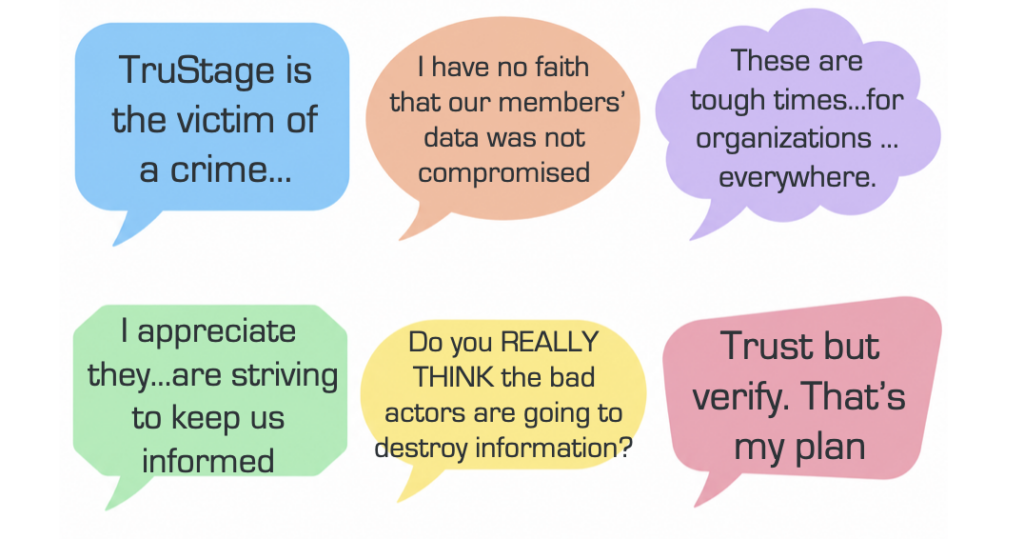
- Except that they knew they were hit with a Ransom attack and for 4 months lied and said they were investigating activity on the network. They knew right away and I have no faith that our members’ data was not compromised
- What you won’t see in this video or read in comments is how the leadership at CUNA (Mutual)/Trustage for years outsourced competent IT staff that constantly warned them about these issues. It was always “too expensive” to invest in software upgrades/updates and to use security software like anti ransomware that could have prevented this.
Leadership’s focus was always on cost cutting through layoffs and hitting 6% growth per quarter. They laid off and off shored many important security positions. (CEOs) caused this by stuffing bonuses into their pockets they earned by causing this mess. Their idea was to milk the cash cow until it was dead, and it looks like it will die soon.
- These are tough times, not only for credit unions, but for organizations and people everywhere. We’re seeing shutdowns, cyberattacks, and disruptions impact even the largest and most sophisticated companies. It’s upsetting personally and professionally. My confidence has been shaken in many areas, but my trust wasn’t just simply given, it was earned over many years. What I appreciate most is authenticity. Sometimes the most honest answer is, “We don’t know.” Uncomfortable, but real.
As TruStage navigates this unprecedented event, does forensic analysis, and builds for the future, I appreciate that they have the resources to investigate and are striving to keep us informed as it evolves. I want to learn more, study the issues, and develop a new lens into what and why. There are not only bad actors out there, but old technology that needs to be modernized. “It’s not a matter of if, but when” and I want to be as prepared as I can be. Explore alternatives. Ask tough questions. Ensure commitments happen. Trust but verify. That’s my plan (not AI), just me. One voice with a passion for all things credit unions. ––Sue Mitchell, MSA
* Do you REALLY THINK the bad actors are going to destroy information obtained in the breach and not release, sell, trade or publish it??
* Interesting, in light of recent news – airlines, banks, even government agencies, all have had “cyber-attacks”, yet none have caused their operation to shut down for months (or even days). Why won’t TruStage allow patrons access their accounts?
The Story
JACKSON, Miss. — In the ongoing case involving one of the largest embezzlements in credit union history, a federal judge entered a preliminary order Friday requiring the former head of Jackson Area Federal Credit Union to forfeit about $69 million and surrender property bought with embezzled funds.
The Feedback
- Sadly, most of the embezzled funds are non-recoverable as they were spent on a luxurious lifestyle not hard assets than can be liquidated. Even the real estate and personal property will be liquidated on a distressed basis. This will be quite a hit to the SIF, which will affect many in one way or another.
The Story
SACRAMENTO, Calif.–SAFE Credit Union says it is aware some people continue to object to its proposed merger with Seattle-based BECU and that a petition has been submitted to the state regulator that seeks to put a pause on the combination but said “positive vote results” mean it is continuing to move forward.
The Feedback
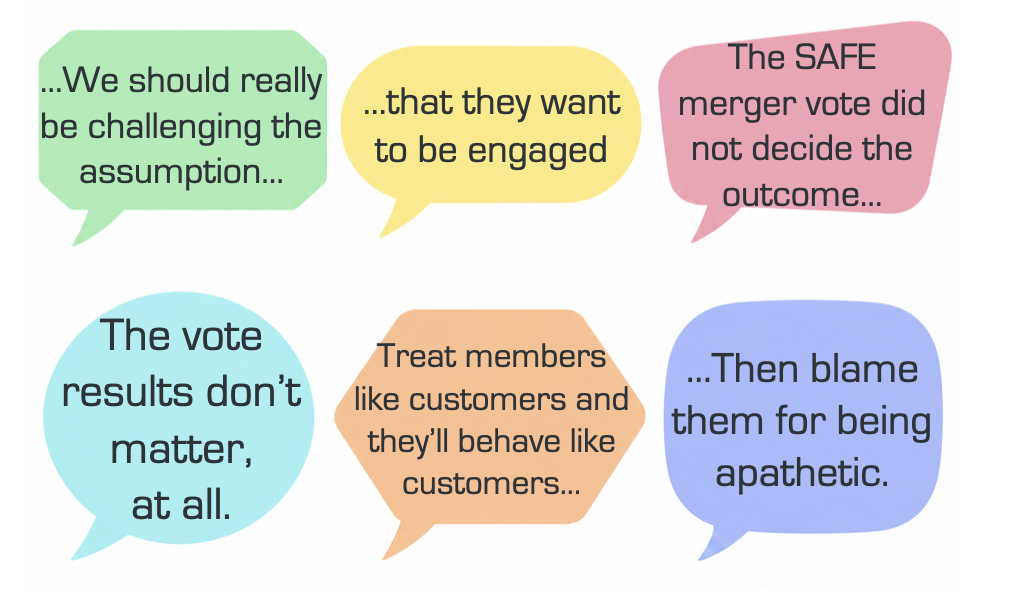
- It’s not about blaming members. Not engaging in governance is member preference, and no one needs to be blamed. They enjoy the rates, products and convenience that our not-for-profit coop model enables, but they seemingly don’t want to be involved in the democratic governance processes. We can say that our lack of education is the barrier to their engagement, but we should really be challenging the assumption that they want to be engaged in the first place, and what they really about their credit union. Ability to vote is way down that list.
- We need to deal with the fact that SAFE member inaction gave away for their credit union, which is the case for most CU mergers.
- We’ve heard a lot in the last few years in divisive elections about apathy, either in not voting or educating yourself. We just can conceive of people having a more extreme or different view that us, and if they do, it’s because they got duped by a message and or they are uneducated. That’s what we’re doing here. A vocal minority thinks this is a bad outcome for SAFE, so that means the silent, unengaged majority must be uneducated.
- There is no relevant or meaningful backlash aside from a few vocal SAFE members, and other pundits that have no standing but seen to think they know better than SAFE members what’s good for their credit union. The majority of members said yes. How does that not fit the narrative?
The issue here is people keep comparing this merger vote to all other types of votes end elections. The problem is that in all the other examples, the vote itself decided the outcome. Like a bank merger or shareholder resolution, the vote results dictate outcome or final decision. The SAFE merger vote did not decide the outcome – election neither approved nor declined the merger. The vote determined the approval path, not the outcome. No point in publishing the election results on an election that doesn’t decide the outcome. That’s the spirit of the CA reg. There was effectively an invalid election, so the CA regulator will use its authority to approve this. The vote results don’t matter, at all.
Disclosing the legal approval path isn’t the same as ensuring members had enough information to make an informed decision. SAFE has described the outcome as “strong member support” without publishing the numbers. Why not show your owners the vote numbers to back that up? It’s yet another claim that SAFE is making without showing its members the evidence.
The public company comparison actually reinforces the point. Shareholders receive voting results. Surely members of a democratically controlled cooperative deserve at least that much transparency.
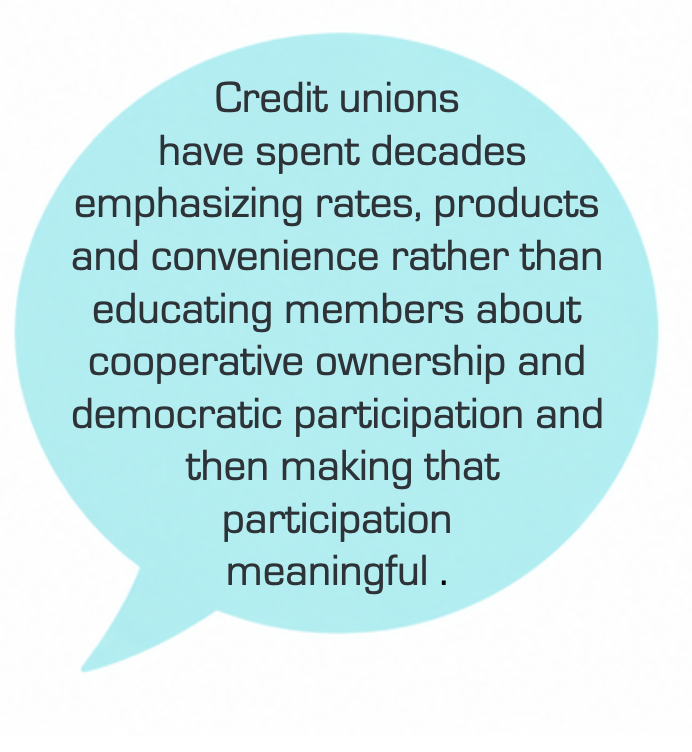
What should really concern us is the suggestion that members simply gave their credit union away. SAFE has reportedly gone decades without a contested board election. Credit unions have spent decades emphasizing rates, products and convenience rather than educating members about cooperative ownership and democratic participation and then making that participation meaningful.
Treat members like customers and they’ll behave like customers. Then blame them for being apathetic. Members have a responsibility to participate, absolutely. But so do the institutions entrusted with fostering democratic member control. Credit unions should be examining both, not using one to excuse the other.
- Because the numbers don’t support the narrative. SAFE has no reason to publish now when it may cause more public backlash. That would not help their case to get DFPI to approve the merger. Governments publish their vote totals. Unions publish theirs. Even public companies, which make no claim to be democratic, have to report shareholder votes within four business days. Credit unions are built on democratic member control. If a company owned by its investors owes its shareholders the count, a cooperative owned by its members owes them that.
- They disclosed up front their intent to use a legal approval path, which was conditional based on the action, or in fact inaction, of members. Can’t get much more transparent than that. We should be careful not to cherry pick how we want to emulate for profit public companies when spend so much time trying to convince everyone how different we are. We have one member, one vote, they vote their shares of stock, and as a result the stockholders make the decision, not a regulator.
Unless they pass a new law, the legislator has no role here, and the DFPI would be spineless to be influenced by them. The governor doesn’t care. It seems some think the DFPI or local government should take some sort of action outside of their scope to bail out the apathy of SAFE members. They energy is directed in the wrong place. SAFE members gave their credit union away, and that’s all they need to know right now.
- This is simple:
1) Majority of voters say no. It’s over. State can’t approve.
2) Majority of members vote yes. It’s approved. No DFPI involvement needed.
3) Majority of voters are a yes, but the yes votes are less than the majority of members, then it goes to DFPI for their approval. DFPI’s action is not a circumvention, override or veto of the member. It one of two lawful, pre-defined and pre-communicated approval paths.
In this case, number 3 happened. In 1 and 2, the vote decides the outcome. In 3, the vote defines the approval path, not the outcome. Therefore, the specific results, aside from already knowing neither 1 or 2 happened, are irrelevant and unactionable. Could be interesting to some, but whether turnout was 7% or 8% or the vote margin was 55/45 or 80/20 means nothing, and there is no point in disclosing it, especially right now.
It’s likely 85-90% of the members didn’t engage and vote, but now it’s some sort of travesty that they aren’t told what are completely irrelevant details about it?
- Who gets to decide what amount of pay is excessive? You? Do you really want exec comp specifically regulated by the NCUA? The regulator should have a fiduciary governance role that supersedes that of a credit union board? Exec pay is a triggering issue for many, especially (if) you don’t stop and think about it. Merger exec outages three primary firms – retention, severance, and SERP and other retirements.
Involuntary job losses occur in the c-suite. What makes severance unreasonable in those circumstances? 1.5 to 2x salary is a norm across many industries. For leaders with no jobs after legal /conversion, would we like them to bail, save themselves and the create excessive pre-conversion and conversion continuity and operational risk? Or is it wise to consider retention payments?
In the case of SAFE, most of the 15 million dollars are in SERP dollars. The merger did not create that liability for SAFE members, it simply accelerated the timing of the payments. Pay it now or pay it later. It’s not some new pot of gold that appeared because the merger happened. People dwelling on pay are focused on the wrong issue and it’s not the catalyst for mergers. Think of public banks, where execs have disclosed change in control agreements. Are the CEOs of $50 billion banks calling Jamie Dimon everyday asking to be acquired so they could get paid? After all, we’re in the high ground and they are the greedy profit mongers, right?
- Just post the results! DFPI should require that prior to moving forward.
- I wonder how many of these mergers would proceed if regulators prohibited executive payouts in merger packages.
- So SAFE members saw a 15 million payday to execs and the majority of voters said yes, let’s merge and the payout is approved. This doesn’t seem anti-consumer, it’s pro-member and advocacy for them to exercise their member-owner right and vote. They had control of this outcome. Democracy. Choice. One member, one vote. If members don’t value that right, don’t read their mail from SAFE and don’t care enough about the outcome to vote, they deserve to own the consequences. That’s not unethical.
The Story
SACRAMENTO, Calif.–A group of members from SAFE Credit Union—with support from others within the credit union community–is pressing California’s Department of Financial Protection and Innovation to pause and review the proposed merger between SAFE and Seattle-based BECU.
The Feedback
- Credit union staff can’t whistle blow, leagues won’t speak out because their dues are based on assets, consultants like CU Collaborate have credit union merger matching services. Meanwhile CEOs are getting multi-million pay outs. Only retired CEOs and former regulators can speak out. When all these mergers gobble up the charters, and then that growth is done and they convert to banks… this is how the credit union movement dies.
BECU’s board of directors, 8 of 9 are from the banking and investment banking industry. They are paid $125,000 each. They aren’t volunteers looking out for the community. Bev Anderson was a banker, and the majority of BECUs executive team are bankers. Let’s be clear this credit union is 1-3 years out from converting to a bank.
As Folsom is just left with branches and SAFE is no longer a credit union, and this merger is just a path to member acquisition and expansion, well… Both Seattle and Folsom lose their credit unions. How many other credit unions will BECU gobble up before converting to a bank?
Why are we silent on this? Fear.
What did thousands of credit union volunteers create? Is their legacy worth fighting for?
- Seriously anti-consumer reply. Can tell you are one of the CEOs that would sell your charter for $1 million or $4. After all, it’s the ignorant members that don’t understand you are selling their charter to fund your big payday. Disgustingly unethical response. What are credit unions coming to?
- Election denying at its best. …”have asked the agency to recognize, among other issues, that many credit union members do not fully understand that the capital belongs to them and they have ownership rights.
At what point does a member owner or voter have to take responsibility? Member ignorance and apathy is on them. Those that voted yes very likely understand that the capital of the combined credit union belongs to them on the save exact way it did before the merger, only that there is more of it.
All the disclosures were within requirements, including SAFE’s intention of asking the CA DFPI to use the authority they have, which was legislated to contemplate this exact scenario of a less than a majority of member yes vote. Pay for execs in mergers has occurred for decades and regulators are going to intervene on that issue. Members that voted, and the Board voted in to represent the entire membership, approved it.
I don’t know why there is unusual interest in this merger, but it’s not unique in any way to other mergers and it will be approved, just as it should be.
Maybe it can be used to highlight the issue of why as CU leaders we think members care about being part of a member-owned cooperative way more than they really do. Start with the total dilution of the common bond concept over time. The bank lobby makes silly arguments like 990 disclosures. If they were smart, they would throw the chronic and systemic lack of member engagement in this member cooperative model we stand on to justify the tax exemption right back in our face.
The Story
SACRAMENTO, Calif.–Questioning why the voting results have not yet been released in a proposed merger of two giant West Coast credit unions that he has called “absurd” and “anti-member,” and suggesting the larger merger trend in credit unions represents “cooperative theft” in many cases, one well-known former NCUA official and consultant has published a strongly worded critique of one what he alleges has been taking place—and not taking place.
The Feedback
- Many credit union members don’t fully understand that they’re owners or the rights that come with ownership. SAFE has reportedly gone decades with uncontested board elections. When was the last time these members were actually given a choice or made to believe their vote mattered?
Credit unions have spent decades treating members more like customers than owners, emphasizing rates, fees, products and services while doing relatively little to educate them about the ownership and democracy that is unique to the cooperative business model. Yet educating members and the public about cooperatives is a responsibility of all cooperatives. It’s part of Cooperative Principle 5.
Treat people like customers and they’ll behave like customers. Blaming members for not participating without examining the institutions responsibility for that disengagement seems to miss a much larger issue.
- Have to disagree. Transparency lends itself to credibility. Based on the celebratory nature of the election “process” by SAFE, it would have been uncharacteristic for them not to have published affirmative results. The merger will just create another big bank less the banking regulation. The staff at Golden 1 has already been briefed on a measured SAFE exodus for customers that care about community/local control. People with loans will likely remain, but people with deposits may relocate. There are alternatives and people are welcome to make alternative choices.
- It’s really difficult to look at this decision by SAFE leadership as anything less than a handful of executives getting richer off the backs of their members. C’est la vie in corporate America. Median household income in Greater Sacramento is around $99k/year. Cost of living is ~23% higher than the national average. Average Americans are struggling to keep up. SAFE’s plan to help their members? Use $15 million of their members’ money to pay off already-wealthy leaders.
(Five executives) get fat golden parachutes while their members get nothing. Is that the spirit of the credit union movement? Seems much more like corporate greed. The entire leadership team and board are covered in the ick. They should be ashamed, but do leeches feel shame?
- The issue here is voter apathy. Chip’s scenario of low turnout with narrow margin is most likely. Assume 20,000 votes out of 245,000 members. Assume 12,000 voted yes, and 8,000 voted no. That means the merger will go forward with an affirmative yes vote from 4.8% of its members. The 225,000 non-voting members, through their inaction, knowingly delegated this “life and death” decision to approve this merger to the CA state regulator.
The idea that low turnout meant SAFE put in “zero effort” inform members is not true. By taking the time to write a few blogs, Chip is more engaged than 225,000 SAFE members. That’s the real issue here.
I don’t see the issue in SAFE not releasing the vote numbers. The process is happening exactly like they said it would. Clearly this was not a no majority among those that turned out, and the final rubber stamp is sitting on someone’s desk at the CA DFPI. Of those that voted, the majority The vote count and margin is irrelevant at this point, and there is no reason or requirement to announce it. The announcement of the final approval will come soon.
Here are the Questions CU Reps Had for NCUA on its Budget Ruling Briefing, and How Agency Responded
The Story
ALEXANDRIA, Va.–Following a presentation by NCUA on its budget, and after they offered feedback and recommendations to NCUA as part of the agency’s budget hearing, four people had the opportunity to NCUA senior staff a number of questions about how the regulator is spending its money, what it prioritizes, what it has planned for examinations, and more.
The Feedback
- So many words, so few answers to questions. Some questions were answered by basically saying “look it up yourself.” Others were handled without actually providing anything of substance. They let a lot of employees go. It sounds like many of those that remain will be sitting somewhere looking at a computer screen rather than actually doing in-person audits. Fewer examiners, fewer credit unions, more money. Not to mention a budget that doesn’t want to go out on a limb to establish a cybersecurity budget for 2028.
The Story
EUGENE, Ore.–Why would a credit union move to a 32-hour workweek while continuing to pay employees their full-time salaries? What does it take to make it really work? It’s about a lot more than just changing the schedule, according to Oregon Community Credit Union, which is sharing with CU Daily readers details around its innovative new employment policy.
The Feedback
- Great plan to steal all the good talent in the market! Of course, it will force small credit union to merge, because they will not have any employees willing to work 40 hours. Finding talent is the hardest thing we all do, OCCU just placed a huge check mark on their side of the ledger for the future employee evaluating employers. Good luck to small credit unions in that market.
The Borrower You Financed Isn’t the Borrower You Serve Today
The Story
Opinion piece by Will Holleman of Equifax, who wrote that maintaining refreshed borrower data allows credit unions to strike the perfect balance between prudent risk management and member service. Initial loan underwriting is just the baseline; continuous data insights help ensure your portfolio strategy stays perfectly aligned with reality.
The Feedback
- Will, you are spot on with these comments!
After four decades in the automotive industry, the one thing that remains the same: CHANGE.
My dealerships have sold thousands of indirect automotive loans per year, many to credit unions. Each loan was sold to the lender that helped my team maximize their profits, so the financial institution paid more than any other lender that day for that deal.
The consumer has a massive affordability problem and wise credit unions should turn to automotive refinance and become the hero in the consumer’s financial journey!
We created Honest Car Payment as the perfect vehicle to help the vehicle owner assesses and secure refunds first and then refinance at the best terms in the market, as compared to the dealership.
Credit unions have a choice, be transactional with the dealership, or relational with the new member.





One Response
I really like how you’ve done this Frank, comparing the story and accompanying feedback. This would be a great feature going forward as we don’t always see the feedback readers leave unless we go back to the story after we’ve read it.