

SACRAMENTO, Calif.–Questioning why the voting results have not yet been released in a proposed merger of two giant West Coast credit unions that he has called “absurd” and “anti-member,” and suggesting the larger merger trend in credit unions represents “cooperative theft” in many cases, one well-known former NCUA official and consultant has published a strongly worded critique of one what he alleges has been taking place—and not taking place.
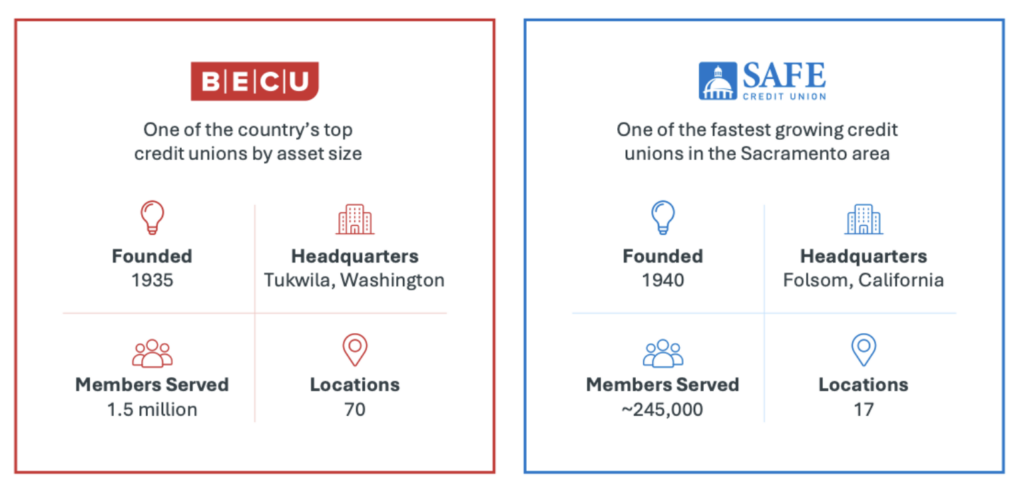
In the blog post, Chip Filson, who regularly publishes his views and observations on his “Just a Member” blog, is challenging the delay in how members of the $4.39-billion, Sacramento, Calif.-based SAFE Credit Union voted on merging into the $29.4-billion, Seattle-based BECU. Filson, the former head of Examination and Insurance at NCUA and a co-founder of Callahan & Associates, has regularly raised issues around the merger on his blog.

As the CU Daily has regularly been reporting, the merger has been controversial from the outset, with one member actively and publicly fighting it, and former credit unions CEOs engaged in a point/counterpoint debate in the media. The member who has been objecting most loudly to the merger, Dr. Scott Rose, met with SAFE CU CEO Faye Nabhani, as reported here.
In an opening note to readers prefacing the column, Filson wrote, “The moral of the following story may be transformational. For the facts of this merger effort are so absurd and anti-member, that the general public can easily see the cooperative crisis at hand. If this event triggers an industry self-examination, then good news may result from this overt corruption of everything credit unions for.”
‘Basic Power of the People’
Noting that in a democracy, the “basic power of the people over their leaders is the right to vote,” Filson noted that on Oct. 27 member voting on the merger was closed at SAFE and pointed out that as of two weeks later, no vote totals have been announced after almost two weeks.
Even prior to the end of the voting SAFE Credit Union had already announcedthat it intended to sidestep California law, which requires state-chartered CUs seeking to merge to get an affirmative vote by a majority of members, of which SAFE CU has nearly 250,000.
Under California Financial Code Section 15201(b), a credit union’s board may apply to the California Commissioner of Financial Institutions for” approval of a merger inaccordance with a plan of merger approved by a majority of the board ofdirectors of each credit union that is a party to the merger, even thoughless than a majority of the outstanding members of a disappearing credit union has voted to approve the merger.”
In the disclosures it provided to members and to NCUA, SAFE CU said it intends to pursue that path.
“…This is to advise you that the Board of Directors will make an application under California Financial Code Section 15201(b) for approval of the Merger in the event that a majority of all members of SAFE do not vote to approve the Merger, in person at the meeting, or by mail-in or online ballot,” SAFE said in its statement to members.
The state regulator declined to comment when contacted by the CU Daily.
A $15-Million Payout
“The elections were called, organized, controlled and managed by one side, that is the five senior managers and the board, seven of whom will directly benefit if the merger is approved. These seven, will be awarded over $15 million in bonuses on top of ongoing salaries and benefits,” Filson wrote.
The CU Daily has coverage of the planned payouts here.
“Why have not totals been released? The only answer is that the facts would undermine the narrative SAFE has been spinning about the merger,” Filson stated. “The data gap could be as simple as the merger was turned down. How do we announce that? Or the vote margin was so narrow that requesting the regulator override the outcome would be inconsistent with protecting members’ best interests.”
Filson noted that if perhaps 90% of the members did not vote, then participation would have been well below the 50% required for state-chartered CUs in a merger.
“This voting gap would demonstrate one thing—that the credit union made zero effort to inform members about this life or death decision of their institution,” Filson suggested. “Instead, they were counting on the auto response of a very few to follow the Notice’s plea to support their leaders into the abyss.”
‘Defeated Political Party’
Filson likened SAFE CU to a “defeated political party” trying to “spin the outcome in an election in which they controlled all the resources and messaging. Low participation undermines any pretense of democratic accountability. It compromises the integrity of the credit union governance process,” he added.
Filson further alleged that “like authoritarian leaders in other democratic contests, SAFE’s incumbents are rigging the outcome to try to thwart both state law and members’ interests.”
Filson’s blog post argues that the merger transfers more than $440 million in capital for free to an “organization that had zero role in generating it and gives the owners $0 for their collective economic interest. Except for the seven insiders who helped themselves off the top.”
As of Sept. 30, SAFE CU, which had $29.95-million in net income through Q3, had net worth of 11.06% (17.71% risk-based ratio). BECU, which had net income of $131.8-million, had net worth of 12.82% (20.69% risk-based ratio) as of the same date.
SAFE has nearly 700 employees and about 244,000 members, while BECU employs roughly 3,200 people and serves more than 1.5 million members.
‘What is Good for the Least’
Filson stated that credit unions were created with one simple approach to member value, which is “what is good for the least is good for all,” and said SAFE is the latest example of “turning this cooperative principle upside down. What is good for senior management…”
“SAFE’s leaders are causing the worst kind of economic harm one can imagine to a credit union and its member-owners,” Filson continued. “It is shutting down their 85-year independent charter, turning over a successful locally focused $4.5 billion financial institution to strangers. SAFE owners had no role in selecting and no information about BECU’s business model. They know nothing about their future fate with BECU’s leadership.”
Filson described the “giveaway” as “worse than financial theft,” alleging SAFE’s leadership is using its position of “trust and accountability to present an option that from the latest data will cost them more for loans, pay them less for savings and require more in overhead expenses.
No ‘Immunity’
“Cooperatives were supposed to be immune from this ever present human impulse to maximize personal gain from those you serve,” he added. “Credit union mergers have devolved into cooperative theft organized by leaders in two organizations who show no capacity to distinguish right from wrong. It is the ethic of the bully, the powerful and those who gained positions of authority via democratic subterfuge.”
Under the subheadline, “A Cooperative Odor is Spreading,” Filson went on to write, “The whole merger effort reeks from this mixture of nonsensical financial proposition, the rhetorical propaganda of PR cliches, and the self-dealing of those entrusted with the stewardship of member-owner wealth.
‘Stench is Spreading’
“This stench is spreading across credit union land, with individuals urging boards and CEO’s to get a good merger deal before it is too late. That is before the public becomes aware and this widening cooperative looting scheme is shut down,” he stated. “SAFE’s example, just one of many, will smear the entire good works, self-discipline and beneficial credit union conduct of those who refuse to play the game of beggar thy neighbor,” he stated. “This industry cannibalization will stop only when credit union leaders who now plead for a common ground of unity move to a higher ground. For it is not just SAFE, but the entire cooperative system that is operating with this internal disease of self-dealing corruption.”
Filson said it is up to the leaders credit unions to step up and “save” the movement, and said the first step would be revealing how SAFE’s membership voted on the merger.”The CU Daily has contacted SAFE Credit Union for comment and will include any response in updated reporting






One Response
The issue here is voter apathy. Chip’s scenario of low turnout with narrow margin is most likely. Assume 20,000 votes out of 245,000 members. Assume 12,000 voted yes, and 8,000 voted no. That means the merger will go forward with an affirmative yes vote from 4.8% of its members. The 225,000 non-voting members, through their inaction, knowingly delegated this “life and death” decision to approve this merger to the CA state regulator.
The idea that low turnout meant SAFE put in “zero effort” inform members is not true. By taking the time to write a few blogs, Chip is more engaged than 225,000 SAFE members. That’s the real issue here.
I don’t see the issue in SAFE not releasing the vote numbers. The process is happening exactly like they said it would. Clearly this was not a no majority among those that turned out, and the final rubber stamp is sitting on someone’s desk at the CA DFPI. Of those that voted, the majority The vote count and margin is irrelevant at this point, and there is no reason or requirement to announce it. The announcement of the final approval will come soon.