

By Frank J. Diekmann

You didn’t need to be more than a few-dozen lanyard-lengths into the airport-sized exhibit hall at the Money 20/20 conference in Las Vegas to realize the theme of the meeting and the current zeitgeist in financial services: Trust, or much more appropriately, the lack thereof.
The trade show is so large it comes with interactive maps and human assistants to help you navigate your way, but it didn’t matter which way you turned—it was all about being authentic and that had nothing to do with self-help or some sort of therapy. Although what’s taking place may drive some to need it.
As the CU Daily reported here, AI-empowered fraud is hitting financial institutions, merchants and consumers at scale. That’s why if you were one of the hundreds and hundreds of vendors at Money 20/20, unless you were peddling stablecoin and related solutions, you were most definitely hawking identity verification and authentication solutions, even if you just pivoted to this new vertical around the same time you were setting up your booth.
All the promise of agentic AI is more than counterbalanced by risk–a risk that is undoubtedly right at the top of you chief risk officer’s (or whomever has this ballooning job responsibility at your shop) to-do and re-do list.
No Firewall Needed
The reason isn’t cryptographically locked behind four layers of firewall.
“What has changed is the significant ramping up of fraud at much lower costs. Instead of fighting a few groups, you’re fighting an army,” Pedro Sanzovo of Plaid said during a session titled, “How to Fight Fraud Perpetrated by an AI-Enabled Attacker.” “There is identity fraud and intent fraud. Identity fraud saw a ramp up in deep fakes. What has surprised me is the big ramp up in intent fraud, which is humans taking advantage of their own identities to commit fraud. You can now ask an LLM how to file for a chargeback, how can I do a credit bust-out. It’s super-easy to create fake documents to corroborate claims being made.”
And that’s just the individual actor. There are nation-states involved in the game who are using AI to supercharge the threat exponentially.
But instead of building moats, most credit unions, fintechs, banks, insurance companies, and everyone from massive trillion-dollar tech companies to that nephew you always found shady and who’s up to something questionable in the garage is racing to jump off the cliff of agentic AI, with only a vague notion of where (or in what) they are going to land. It’s 24/7 FOMO and we’ll figure it out later. Maybe.

Unauthorized Third Parties
The same week the Money 20/20 meeting was filling the Venetian, the largest banks all said they were detecting unauthorized third-party artificial intelligence agents operating inside customer accounts, including some that appear to be taking actions independent of users’ instructions. The big banks said they were blocking customers’ (or were they?) agents as they struggled to distinguish between legitimate customer activity and automated agents that may have access to account credentials and the ability to move money.

Two Observations Worth Sharing
A couple of observations to share, the first from Jarad Fisher, VP with United Airlines’ MileagePlus program, who wasn’t directly speaking to credit unions but whose advice may bring a bit of comfort.
“In agentic commerce, we are in the very, very early days–in the first or second batter of the first inning,” Fisher said. “We have to keep a close watch, the winners here will be some of the brands that don’t dive all the way in and do too much, too fast. Instead, they will use some small use-cases to engender trust and get people to use them.”
The second observation came from Arvind Srinivas, co-founder and CEO at Perplexity, who also wasn’t speaking directly to credit unions, who cautioned that no one should get too comfortable. “What I’m excited about over the next few years is AI is moving from a tool that answers with what is already known, to something that can predict the unknown to a reasonable degree of accuracy. That is where the frontier lies,” Srinivas said.
Stop Me If You’ve Heard This Before
You may have heard that what goes around comes around, and as I negotiated the acres of the Money 20/20 trade show I was hit by what had come around for credit unions. The “union” piece exists as a risk mitigation tool. CUs had their roots in a day when “character loans” were a thing; that is, members could vouch for the “character” of a borrower at a time when there were no credit bureaus and FICO stood for a “Friend in the Company.” That is, “We know Stan from the loading dock and he’ll make good on the loan.”
In other words, trust and authentication.
Where to Read More
The CU Daily’s coverage from Money 20/20 can be found here:
- How Can a CU Fight Fraud Perpetrated by AI? Three Actual Humans Offer Some Answers
- Money 20/20 Coverage: How PayPal Sees Market Changing and What it Has Planned
- Money 20/20 Coverage: How United Airlines, Synchrony, See Card Ecosystem Evolving and How They are Responding
- Money 20/20 Coverage: FDIC Chair Challenges That Will Sound Familiar to CUs
- Money 20/20 Coverage: What the ‘Next Frontier’ for AI, Finance Looks Like
- Money 20/20 Coverage: A Look at Some of the Products, Solutions Announced During Show
- Money 20/20 Coverage: 5 Views on Everything from Shifting Role of FIs to View from the White House

What Happens in Vegas…Never Fails to Surprise
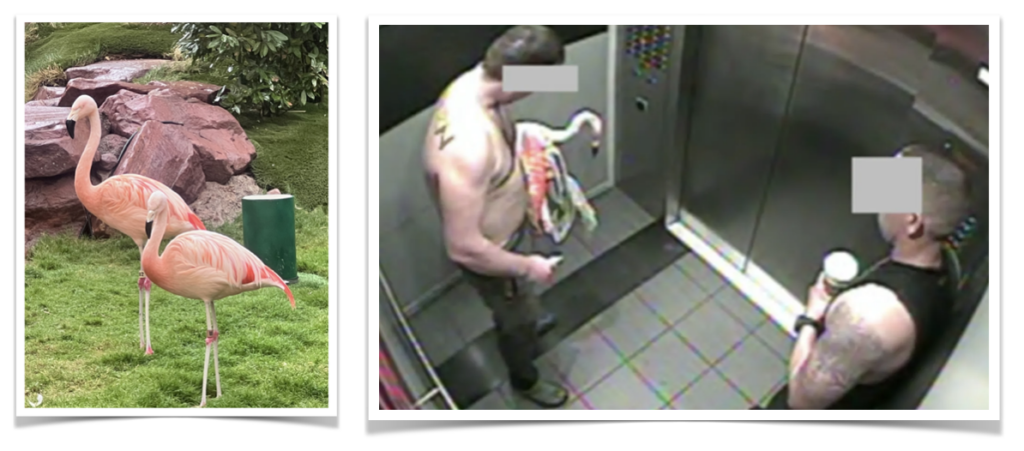
In The Flamingo Hotel there is–surprise!–an actual flamingo habitat. Thinking this has to be among the easiest jobs in the world, I joked to a security guard that he was doing a great job keeping the flamingos safe. But the joke was on me.
Turns out, the same week I was in town for the Money 20/20 conference, Mitchell Fairborn, a Canadian tourist, was found guilty of animal cruelty for earlier jumping over the barrier, crossing through some water and taking a flamingo named Peachy back to his hotel room.
Mitchell told the court–surprise 2.0–he was intoxicated and had drunk 30 to 40 beers before he decided the flamingo-napping would be one fine idea.
“He should not have done that,” his attorney told the court. You think?
I would have thought being caught pink-handed would be evidence enough, but the trial involved 14 witnesses and 112 pieces of evidence, according to CBS. And then another five hours for the jury to convict him on felony charges. I would have loved to have heard that debate.
Still Under House Arrest
Fairborn has been unable to leave the United States since his arrest, and he remains on house arrest in Las Vegas until his sentencing hearing in December.
The security guard told me, btw, that Fairborn hasn’t been the only person to attempt to steal a flamingo, hence why there is now always a guard on hand.
Peachy, incidentally, has recovered, although a veterinarian said he now has a “more anxious demeanor” around humans. Don’t we all.
You Should be Grounded
Actual overheard conversation in the Atlanta airport. A large group of people had started to form a mob around a gate where a flight is to depart for Daytona Beach, Florida. The gate agent announced boarding was about to begin for Daytona Beach. A woman who is waiting for a separate flight asked, “Does Daytona Beach have an airport?”
Of course not. As everyone knows, flights land at the city’s famous raceway.
This is the Message You Settled On?
Frank J. Diekmann is cooperator-in-chief with the CU Daily and can be reached at [email protected].